
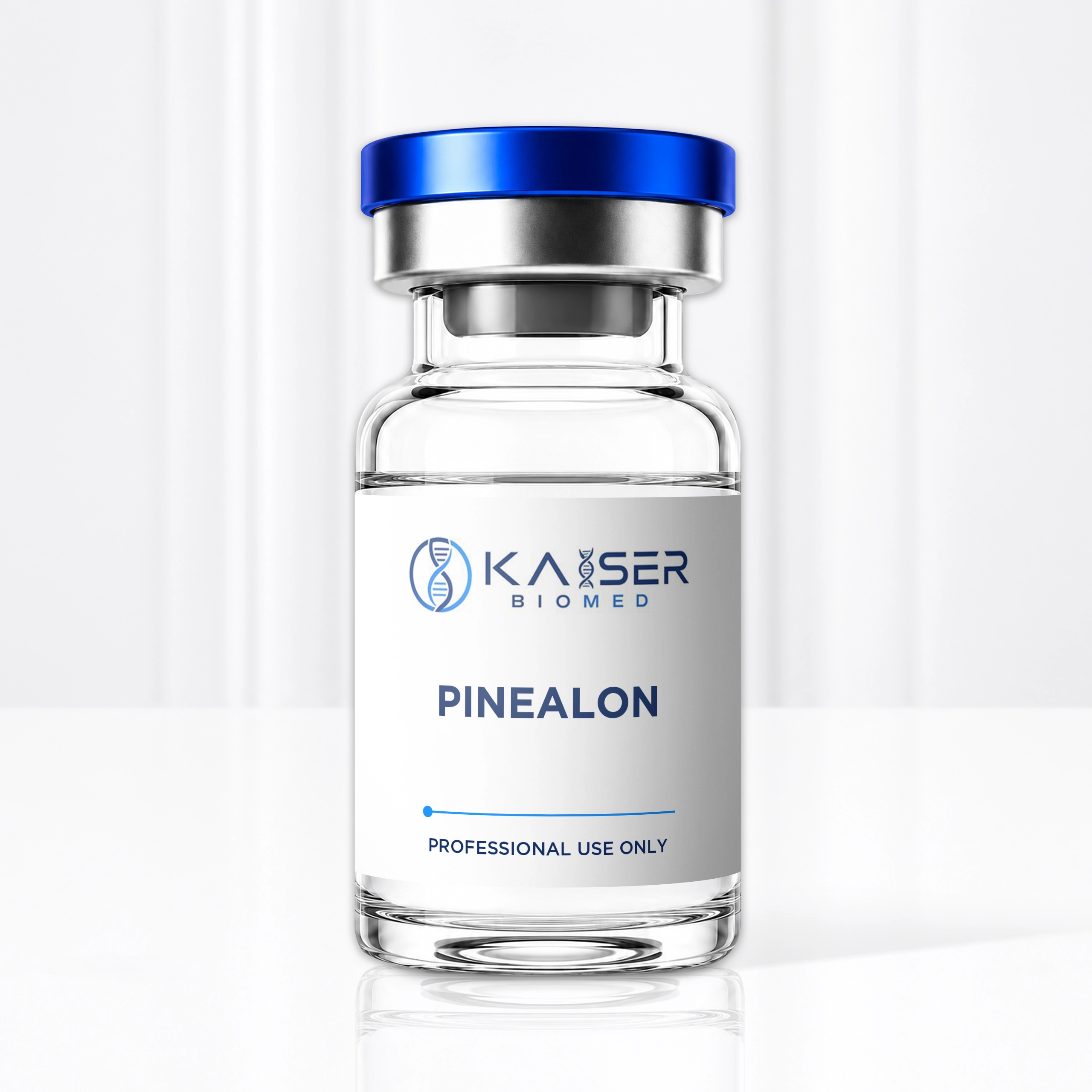
Description
Summary Abstract
Pinealon (L-Glutamyl-L-aspartyl-L-arginine; Glu-Asp-Arg; EDR; T-33 peptide; C15H26N6O8; MW 418.40 g/mol; PubChem CID 10273502) is a synthetic tripeptide bioregulator developed through the analysis of Cortexin — a bovine cerebral-cortex polypeptide extract — as part of the Khavinson peptide bioregulator research program initiated at the S.M. Kirov Military Medical Academy in the 1970s. Pinealon represents the most frequently recurring amino acid sequence within Cortexin, synthesized as a stable, defined single-entity analog. Its proposed mechanisms of action operate at multiple cellular levels: dose-dependent reduction of reactive oxygen species (ROS) accumulation, modulation of the ERK 1/2 signaling cascade to prevent stress-induced apoptotic activation, mitochondrial function support, stimulation of endogenous antioxidant enzymes (SOD, glutathione peroxidase), and — uniquely among peptide bioregulators — direct nuclear penetration with preferential binding to CNG DNA motifs implicated in cytosine methylation, potentially enabling epigenetic gene-expression regulation. Preclinical evidence spans PC12 cell viability under H₂O₂ challenge, cognitive improvement in aged macaques, offspring neuroprotection in a prenatal hyperhomocysteinemia rat model, and dendritic-spine preservation in 5xFAD Alzheimer’s transgenic mice. Limited human clinical data (TBI and age-related cognitive decline) are promising but lack the methodological rigor of large-scale randomized controlled trials.
Clinical Indications
Pinealon’s multi-level cellular protection positions it across neurological and geroprotective domains:
- Traumatic Brain Injury (TBI) and Cerebrasthenia: In a human cohort (n=72), Pinealon adjunct therapy improved working memory in 59.4% of patients, reduced headache burden, improved emotional stability, and increased EEG alpha-wave index.
- Age-Related Cognitive Decline: In elderly patients (41–83 years) with organic brain syndrome, Pinealon improved CNS activity parameters and slowed biological aging markers; effect size was meaningful though smaller than the comparator peptide Vesugen in the same cohort.
- Alzheimer’s Disease (Dendritic Spine Preservation): In 5xFAD transgenic mice, Pinealon prevented CA1 hippocampal dendritic-spine loss, restoring spine density to healthy control levels — a direct structural correlate of memory preservation.
- Hypoxic and Ischemic Neuroprotection: In hypobaric hypoxia rodent models, Pinealon-treated animals showed significantly longer time to respiratory arrest and improved post-hypoxic recovery, relevant to stroke and ischemia research contexts.
- Metabolic Stress Neuroprotection (Diabetes Model): In streptozotocin-diabetic rats, Pinealon maintained learning retention compared to untreated controls, indicating potential utility in metabolic-disease-associated cognitive decline.
Contraindications
- Known Hypersensitivity: Allergy to Pinealon or its constituent amino acids (Glu, Asp, Arg) is an absolute contraindication.
- Pregnancy and Breastfeeding: Safety not established; Pinealon has demonstrated placental transfer in rat models with fetal neurological effects — potential effects on human fetal development are unknown.
- Epilepsy and Seizure Disorders: As a centrally active genomic regulator, theoretical risk of lowering seizure threshold warrants caution in patients with known seizure history.
- Active Malignancy: Influence on apoptotic pathways (caspase-3 modulation) and gene expression in proliferating cells creates theoretical oncological uncertainty; use with caution pending further data.
Mechanism of Action (MOA)
Pinealon operates through a multi-level, concentration-dependent hierarchy of cellular protection that extends from immediate ROS neutralization to deep genomic regulation:
Oxidative Stress Attenuation
Pinealon dose-dependently reduces reactive oxygen species (ROS) accumulation in cerebellar granule cells, neutrophils, and PC12 neuronal cells exposed to ouabain, homocysteine, and H₂O₂. The mechanism involves both direct free-radical scavenging and stimulation of endogenous antioxidant enzymes — superoxide dismutase (SOD) and glutathione peroxidase — enhancing the cell’s intrinsic oxidative-stress defense system. This antioxidant action is saturated at lower concentrations.
ERK 1/2 Pathway Modulation
Under intense neuronal stress, rapid and sustained ERK 1/2 activation paradoxically triggers pro-apoptotic programs. Pinealon suppresses and delays stress-induced ERK 1/2 activation in homocysteine-challenged rat cerebellar granule cells, providing the cell additional time to engage repair mechanisms before committing to apoptosis. This action represents protective modulation rather than complete pathway inhibition, preserving normal ERK signaling in unstressed conditions.
Epigenetic Genomic Regulation
At higher concentrations, Pinealon demonstrates dose-response effects on cell-cycle regulation that are not explained by cytoplasmic signaling alone. Fluorescence-quenching studies confirm that Pinealon penetrates the nucleus and binds preferentially to CNG deoxyribooligonucleotide sequences — primary targets for cytosine DNA methylation. This epigenetic interaction may regulate the expression of genes critical for neuronal repair, synaptic plasticity, and the synthesis of structural proteins, providing a mechanism for long-term neurorestorative effects that outlast acute peptide exposure.
Mitochondrial and Serotonin Support
Pinealon is described as a mitochondrial booster, protecting these organelles from stress-induced dysfunction to maintain ATP synthesis efficiency and reduce intrinsic apoptotic pathway activation. In brain cortex cell cultures, Pinealon also stimulates serotonin expression and synthesis, suggesting complementary neurotransmitter-level modulation alongside its cellular-protection mechanisms. This serotonergic component aligns with reported improvements in emotional balance and circadian regulation in clinical reports.
Key Features & Specifications
Pinealon’s defined synthetic identity differentiates it from earlier heterogeneous polypeptide brain extracts:
Chemical Analysis
| Property | Specification Reference Data |
|---|---|
| Sequence | L-Glu–L-Asp–L-Arg (EDR; single-letter code) |
| CAS Number | Not formally assigned as a drug entity; Glu-Asp-Arg tripeptide CID: 10273502 |
| Molecular Formula | C15H26N6O8 |
| Molecular Weight | 418.40 g/mol |
| PubChem CID | 10273502 |
| Synonyms | Glu-Asp-Arg, EDR peptide, L-Glutamyl-L-aspartyl-L-arginine, T-33 peptide, Пинеалон (Pinealon) |
| Form / Variation | 20 MG (SKU P-019) |
Storage, Safety, and Handling
Storage Protocol
Store lyophilized Pinealon at 2–8 °C, desiccated, and protected from light. The tripeptide is chemically stable under these conditions. Reconstitute in sterile bacteriostatic water or 0.9% NaCl immediately before use; use reconstituted solution promptly. Aliquot any excess reconstituted material and store at −20 °C; avoid repeated freeze-thaw cycles.
Handling & Compliance
Handle with standard laboratory PPE. Published clinical data report no contraindications, complications, or addiction signals in available trial cohorts, though these studies lack full methodological transparency. Potential adverse events from class-level peptide literature include transient injection-site reactions, mild neurological effects (vivid dreams, mild headache), and rare gastrointestinal discomfort. Long-term epigenetic effects of chronic Pinealon administration in humans have not been characterized in large-scale, independently validated studies; protocol design should account for this evidence gap.