
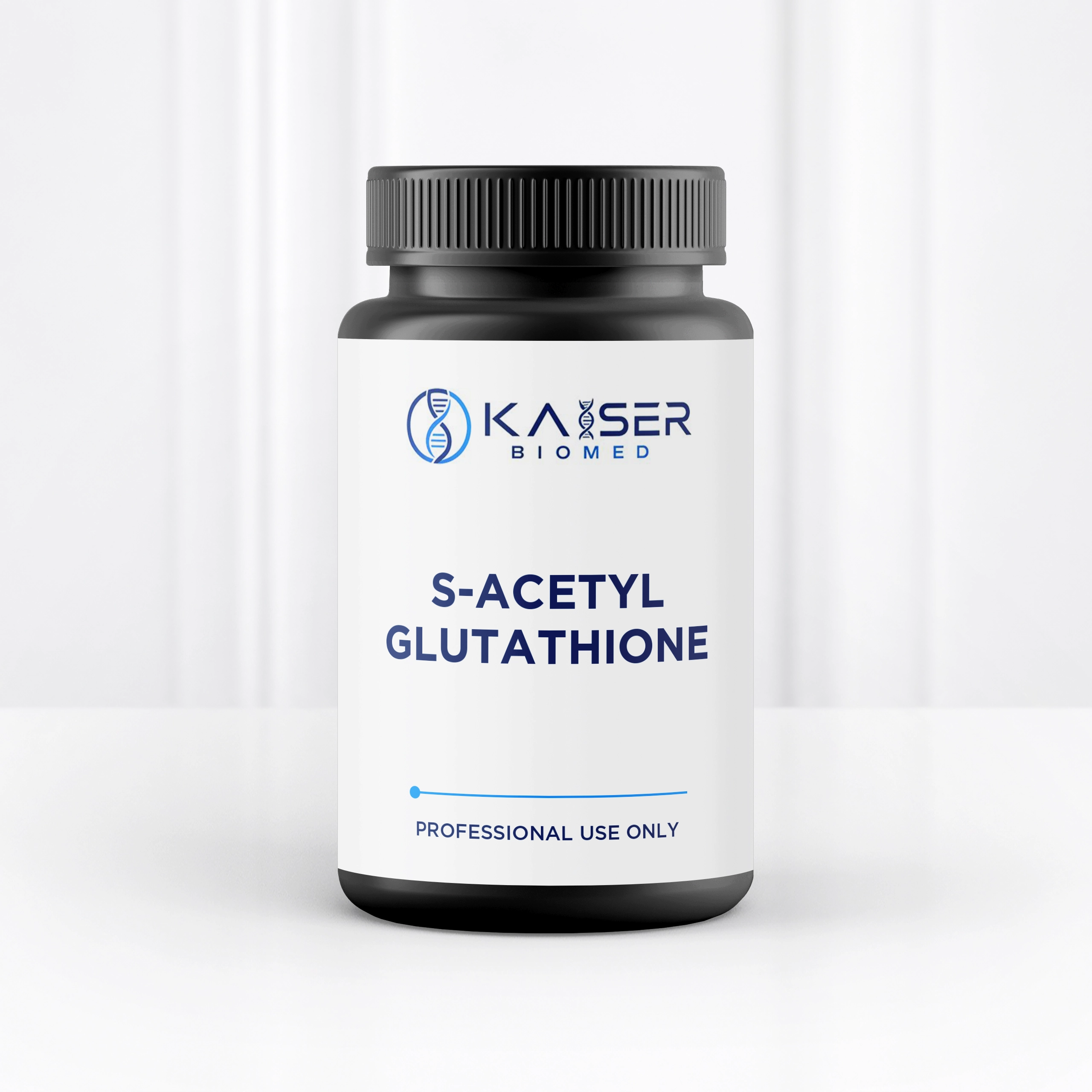
Description
Summary Abstract
S-Acetyl Glutathione (SAG; S-acetyl-L-glutathione; CAS 3054-47-5) is a prodrug form of reduced glutathione (GSH) in which an acetyl group is covalently attached to the sulfur atom of the cysteine residue via a thioester bond. This structural modification protects the reactive thiol from oxidative degradation by γ-glutamyltransferase (GGT) and brush-border enzymatic hydrolysis in the gastrointestinal tract, substantially improving oral bioavailability relative to native GSH. Once absorbed, SAG crosses cell membranes through passive diffusion facilitated by its increased lipophilicity, and cytoplasmic thioesterases cleave the acetyl moiety to regenerate active, reduced glutathione intracellularly. Clinical bioavailability data confirm that a single oral dose of SAG produces significantly higher plasma GSH area-under-the-curve (AUC) and maximum concentration (Cmax) than equivalent doses of reduced GSH.
Clinical Indications
SAG is studied in contexts where intracellular glutathione replenishment is the investigational objective:
- Oxidative stress and cellular redox research: SAG replenishes the cytosolic and mitochondrial GSH pools, restoring peroxide detoxification capacity via glutathione peroxidase (GPx) and glutathione S-transferase (GST) pathways; investigated in metabolic syndrome, hepatotoxicity, and radiation injury models.
- Hepatic protection: Preclinical and early clinical evidence supports SAG in attenuating oxidative hepatic injury; human studies in patients with metabolic syndrome demonstrate GSH restoration in peripheral stores.
- Immune function and antiviral research: Intracellular GSH levels are a key determinant of lymphocyte proliferative capacity; SAG is studied as a tool to examine GSH-dependent immune cell signaling.
Contraindications
- Drug conjugation interactions: Because GSH is the primary substrate for Phase II glutathione S-transferase conjugation reactions, SAG supplementation may alter the detoxification kinetics of co-administered electrophilic compounds in enzyme-activity studies.
- Models with GSH-sensitive redox endpoints: Exogenous GSH delivery will confound assays that measure endogenous GSH production, turnover, or synthesis rate unless appropriate controls are incorporated.
- Hemolytic conditions: Rapid shifts in erythrocyte redox state may be relevant in models involving G6PD deficiency or hemolytic anemia; GSH flux dynamics in red cells should be monitored.
Mechanism of Action (MOA)
SAG functions as a prodrug delivering intracellular reduced glutathione through a multi-step absorption-conversion pathway:
GI Tract Stability and Chylomicron Absorption
The S-acetyl thioester bond protects the cysteine thiol from γ-glutamyltransferase (GGT) cleavage at the intestinal brush border — the primary barrier to native GSH absorption. SAG is taken up intact by enterocytes via passive transcellular diffusion, enhanced by the acetyl group’s increased lipophilicity, and transported into systemic circulation via chylomicrons.
Intracellular Thioesterase-Mediated Deacetylation
Inside the cell, non-specific cytoplasmic thioesterases efficiently cleave the thioester bond, releasing native reduced glutathione (GSH) and acetate. This intracellular conversion bypasses the need for de novo GSH synthesis from constituent amino acids and directly replenishes the cytosolic and mitochondrial GSH pools.
Peroxide Detoxification and Redox Buffering
Released GSH participates as a cofactor for glutathione peroxidase (GPx) in the reduction of hydrogen peroxide and lipid hydroperoxides to water and lipid alcohols, forming oxidized glutathione disulfide (GSSG). Glutathione reductase (GR) regenerates GSH from GSSG using NADPH, maintaining the cellular GSH:GSSG ratio as a key redox homeostasis parameter.
Electrophile Conjugation and Xenobiotic Detoxification
Intracellular GSH is the obligate substrate for glutathione S-transferase (GST)–mediated Phase II conjugation of reactive electrophiles, drugs, and oxidized metabolites, facilitating their mercapturic acid export. SAG delivery therefore supports investigations into xenobiotic detoxification capacity and electrophile-induced cytotoxicity.
Key Features & Specifications
SAG provides a pharmacologically validated, orally bioavailable route to intracellular GSH replenishment:
Chemical Analysis
| Property | Specification Reference Data |
|---|---|
| IUPAC Name | (2S)-5-[[(2R)-3-acetylsulfanyl-1-(carboxymethylamino)-1-oxopropan-2-yl]amino]-2-amino-5-oxopentanoic acid |
| CAS Number | 3054-47-5 |
| Molecular Formula | C12H19N3O7S |
| Molecular Weight | 349.36 g/mol |
| PubChem CID | 9894372 |
| Synonyms | S-acetyl-L-glutathione, SAG, L-γ-glutamyl-S-acetyl-L-cysteinylglycine, Emothion (branded) |
| Form / Variation | 200 MG Capsules — C-036 ($48.00) |
Storage, Safety, and Handling
Storage Protocol
Store capsules at controlled room temperature (15–25 °C) in a dry location, protected from light and humidity. The thioester bond is susceptible to hydrolysis under moist or elevated-temperature conditions. Bulk powder should be kept in sealed containers with desiccant at 2–8 °C; avoid repeated temperature cycling.
Handling & Compliance
Handle with standard laboratory PPE. SAG is a dietary supplement ingredient and is not subject to controlled substance regulation. Researchers should document baseline and follow-up GSH measures when designing comparative bioavailability or oxidative stress intervention studies to ensure appropriate controls for endogenous GSH synthesis variability.