
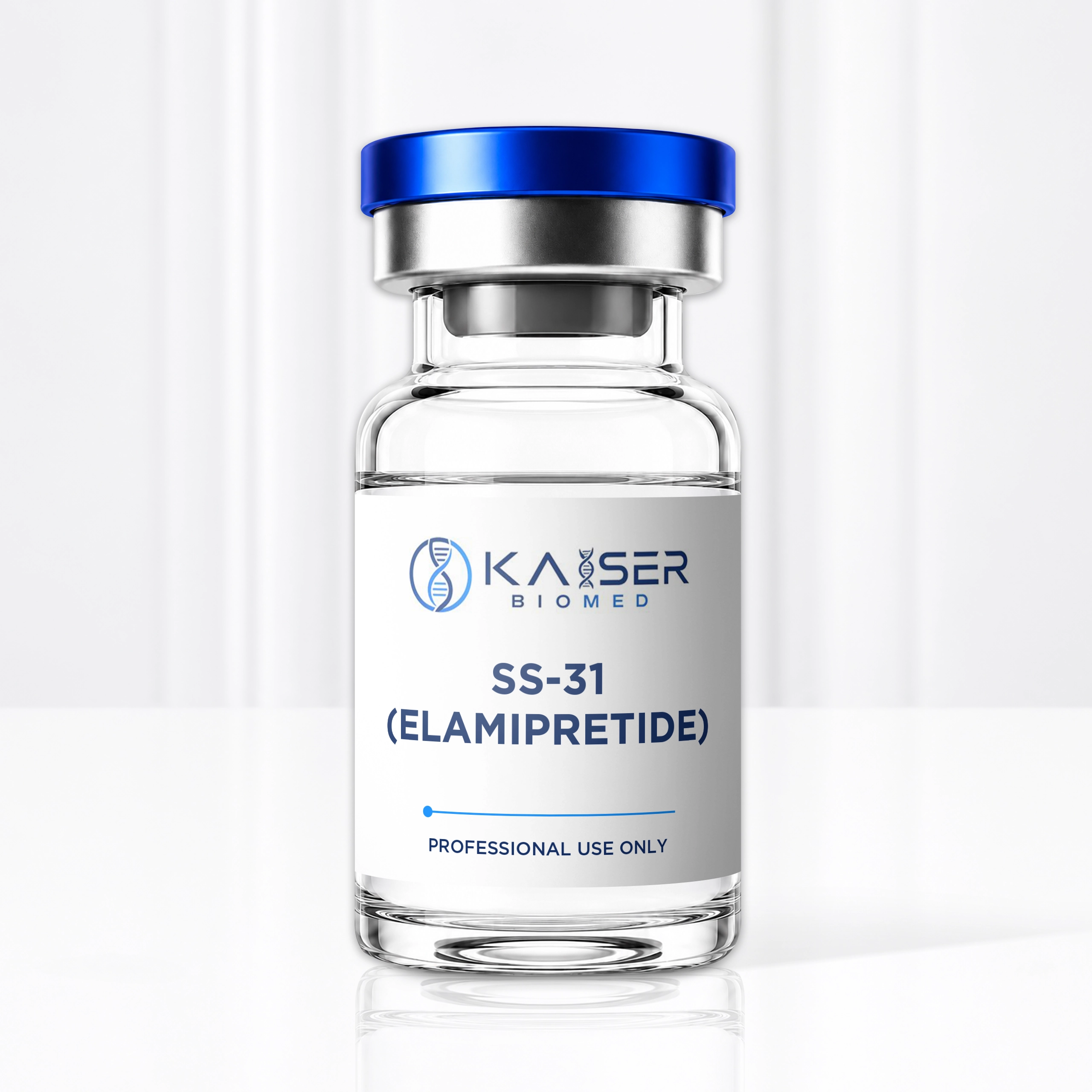
Description
Summary Abstract
SS-31 (Elamipretide; Bendavia; MTP-131; Forzinity; D-Arg-2′,6′-dimethyltyrosine-Lys-Phe-NH₂; CAS 736992-21-5; MW 639.79 g/mol) is a synthetic aromatic-cationic tetrapeptide of the Szeto-Schiller (SS) peptide class, engineered to selectively concentrate in the inner mitochondrial membrane (IMM) and bind cardiolipin with nanomolar affinity. Cardiolipin is the structural phospholipid responsible for maintaining cristae curvature, organizing electron transport chain (ETC) supercomplexes, and anchoring cytochrome c in its electron-carrier conformation. By binding cardiolipin, SS-31 prevents cytochrome c peroxidase conversion, preserves ETC supercomplex integrity, reduces reactive oxygen species (ROS) generation, and restores ATP synthesis capacity in compromised mitochondria. The compound received FDA accelerated approval in September 2025 (brand name Forzinity) for Barth syndrome — a rare X-linked cardiolipin remodeling disorder — marking it as the first mitochondria-targeted peptide therapy to reach regulatory approval. Clinical development across primary mitochondrial myopathy, heart failure, and age-related macular degeneration continues.
Clinical Indications
SS-31 has been investigated in Phase 2 and Phase 3 clinical programs across indications defined by underlying mitochondrial dysfunction:
- Barth Syndrome: FDA accelerated approval (September 2025) based on the TAZPOWER trial, which demonstrated significant improvements in five-times sit-to-stand performance and six-minute walk distance in males with genetically confirmed Barth syndrome; the 168-week open-label extension confirmed sustained functional benefit (PMID 38602181).
- Primary Mitochondrial Myopathy (PMM): The Phase 3 MMPOWER-3 trial (N=218; PMID 37268435) did not meet co-primary endpoints in the full heterogeneous PMM population; post hoc genotype stratification identified a responder subgroup — specifically participants with nuclear DNA point mutations — showing directional improvements in six-minute walk distance (PMID 39574155).
- Cardiac and Renal Ischemia-Reperfusion: Preclinical and Phase 2 data in atherosclerotic renal artery stenosis demonstrated improved renal blood flow and cortical perfusion following IV SS-31 infusion; cardiac ischemia-reperfusion models show accelerated ATP recovery and preserved cristae morphology.
Contraindications
- Neonates: As with all benzyl-alcohol-reconstituted peptides, neonatal use is contraindicated if bacteriostatic water is used as reconstitution medium; preservative-free diluents should be considered for this population.
- Advanced Mitochondrial DNA Deletion Disorders: MMPOWER-3 post hoc analysis indicates that patients with large-scale mtDNA deletions did not respond to SS-31; the compound stabilizes intact ETC proteins but cannot compensate for structurally defective mtDNA-encoded subunits.
- Known Hypersensitivity to Aromatic-Cationic Peptides: Hypersensitivity reactions, while not commonly reported in clinical trials, are possible given the aromatic (dimethyltyrosine) and cationic (D-Arg, Lys) residues in the sequence.
- Injection-Site Reactions: The most commonly reported adverse event in clinical trials is mild-to-moderate injection-site reaction; subcutaneous administration should rotate injection sites.
Mechanism of Action (MOA)
SS-31 operates through a highly specific mitochondrial membrane interaction, affecting ETC function at the level of cristae ultrastructure:
Cardiolipin Binding and Cristae Stabilization
SS-31 binds cardiolipin on the inner mitochondrial membrane with high selectivity (confirmed by Birk et al. using NMR and fluorescence assays in synthetic liposomes of defined lipid composition), with approximately 1:1 stoichiometry. This binding stabilizes the curvature of mitochondrial cristae — the invaginations where ETC complexes cluster — preventing the cristae flattening that disrupts supercomplex organization and leads to increased electron leak and ROS generation.
Cytochrome c Peroxidase Prevention
Under conditions of mitochondrial stress, cardiolipin oxidation converts cytochrome c from its electron-carrier role to a destructive peroxidase, catalyzing further cardiolipin peroxidation and initiating the apoptotic cascade. SS-31 competes with cytochrome c for cardiolipin binding, maintaining the Met80-haem bond and preserving cytochrome c‘s electron-carrying function while inhibiting cardiolipin peroxidation — the principal mechanism demonstrated in the Szeto (2014) British Journal of Pharmacology review (PMID 24117165).
ETC Supercomplex Integrity and ATP Recovery
Cross-linking mass spectrometry studies (Chavez et al., PNAS 2020; PMID 32513690) identified direct SS-31 interactions with ETC Complex I subunits (NDUA4 in Complex IV), ATP synthase (CV), adenine nucleotide translocase (ADT1), and 2-oxoglutarate dehydrogenase components — all known cardiolipin-binding proteins. These interactions improve state 3 respiration, increase phosphate/oxygen (P/O) ratio, and accelerate ATP recovery following ischemic events in a manner dependent on the compound’s cardiolipin-binding capacity.
Mitochondrial Permeability Transition Pore (mPTP) Inhibition
SS-31 inhibits opening of the mitochondrial permeability transition pore (mPTP) — the catastrophic channel whose opening leads to mitochondrial swelling, cytochrome c release, and necrotic or apoptotic cell death. By preserving cristae architecture and cardiolipin integrity upstream of mPTP regulation, SS-31 provides a cardiolipin-dependent barrier to mPTP-driven cell death observed in ischemia-reperfusion, neurotoxic insult, and metabolic stress models.
Key Features & Specifications
Defining pharmacological and structural attributes of SS-31:
Chemical Analysis
| Property | Specification Reference Data |
|---|---|
| Sequence | D-Arg – 2′,6′-Dimethyltyrosine (Dmt) – Lys – Phe – NH₂ (4 AA; C-terminal amide; D-configuration at Arg) |
| CAS Number | 736992-21-5 |
| Molecular Formula | C32H49N9O5 |
| Molecular Weight | 639.79 g/mol |
| Synonyms | Elamipretide; Bendavia; MTP-131; Forzinity; Szeto-Schiller Peptide 31 |
| FDA Status | Accelerated approval (September 2025) for Barth syndrome; investigational for PMM, AMD, heart failure |
| Form / Variation | Lyophilized powder, 40 mg/vial equivalent dosing used in clinical trials (P-088) |
Storage, Safety, and Handling
Storage Protocol
Store lyophilized SS-31 at −20 °C, protected from light and moisture. Upon reconstitution with bacteriostatic water (or preservative-free sterile water for injection where appropriate), store at 2–8 °C and use within 28 days; avoid freeze-thaw cycling of the reconstituted solution. The aromatic-cationic residues in SS-31 confer stability superior to many larger peptides, but prolonged exposure to elevated temperature or light accelerates oxidation of the dimethyltyrosine residue.
Handling & Compliance
Handle with standard laboratory PPE under aseptic technique. Clinical trials have administered SS-31 subcutaneously at 40 mg/day; injection-site reactions (erythema, bruising) are the most commonly reported adverse events, with no serious drug-related adverse events identified across Phase 2 and Phase 3 programs. SS-31 is not currently listed on the WADA Prohibited List; however, as a pharmacologically active mitochondrial agent, researchers should consult current WADA S4 and S5 classification updates relevant to their study context.