
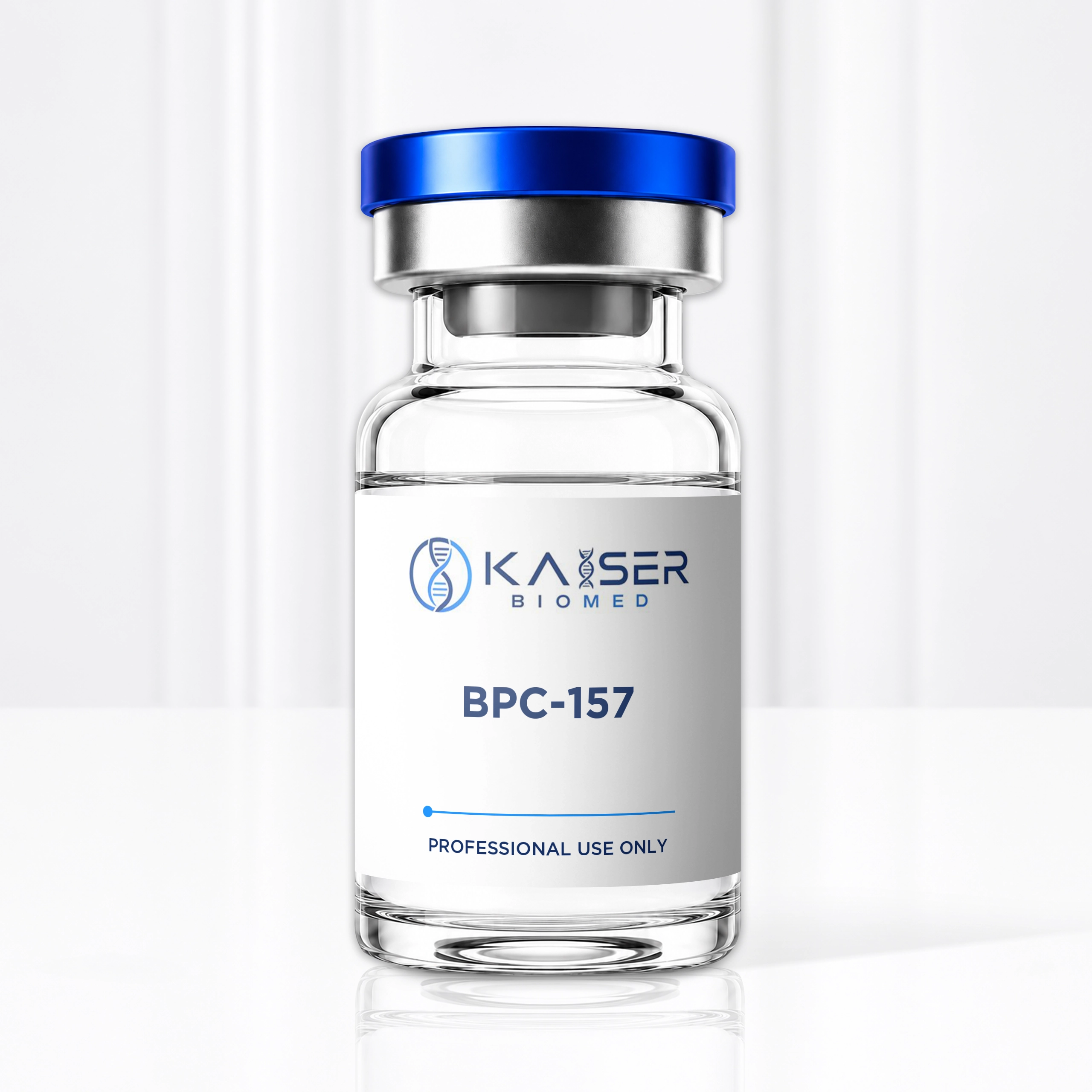
Description
Summary Abstract
BPC-157 (Body Protection Compound-157; GEPPPGKPADDAGLV; CAS 137525-51-0; MW 1419.53 g/mol) is a synthetic pentadecapeptide derived from a gastric juice protein sequence, isolated and characterized by Sikirić and colleagues in the early 1990s. Preclinical evidence spanning more than three decades implicates BPC-157 in multi-modal tissue repair — specifically via modulation of the nitric oxide (NO) system, upregulation of vascular endothelial growth factor receptor 2 (VEGFR2), and activation of the focal adhesion kinase–paxillin (FAK-paxillin) integrin pathway governing cell migration. The compound has demonstrated cytoprotective activity in gastric mucosal injury models, accelerated tendon and ligament repair in rodent transection studies, and attenuated skeletal and smooth muscle ischemia. Available in lyophilized injectable form (5 MG and 10 MG vials) and as oral capsules (500 MCG), BPC-157 is among the most extensively characterized synthetic peptides in the preclinical repair biology literature.
Clinical Indications
Preclinical research across multiple organ systems supports investigation in the following contexts:
- Gastric and Intestinal Mucosal Protection: BPC-157 was originally characterized as a cytoprotective agent in the gastric mucosa; preclinical data show prevention and reversal of NSAID-induced and stress-induced gastric lesions via prostaglandin and NO pathway modulation.
- Tendon, Ligament, and Bone Repair: Rat Achilles tendon transection and anterior cruciate ligament (ACL) models demonstrate accelerated collagen fiber alignment, increased fibroblast proliferation, and faster tensile strength recovery with BPC-157 administration.
- Systemic Anti-Inflammatory and Neuroprotective Activity: BPC-157 attenuates dopamine system disruption, modulates serotonin turnover, and demonstrates neuroprotective effects in traumatic brain injury and spinal cord crush models in rodents.
- Vascular and Ischemic Injury: Angiogenic effects mediated by VEGFR2 upregulation have been documented in ischemic limb and fistula-healing models, with evidence of new vessel formation improving tissue perfusion.
Contraindications
- Active Malignancy: Pro-angiogenic mechanisms (VEGFR2/NO axis) present a theoretical risk of supporting tumor vascularization; use in oncological contexts requires consideration of tumor angiogenesis potential.
- Concurrent NSAID or Anticoagulant Therapy: Although BPC-157 counters NSAID-induced gastric injury in preclinical models, pharmacodynamic interactions with anticoagulants in the context of enhanced angiogenesis have not been formally characterized in humans.
- Neonates and Pediatric Populations: Safety data in pediatric populations are absent; use is not established.
- Known Peptide Hypersensitivity: As with all synthetic peptides, hypersensitivity reactions are possible in individuals with documented peptide or excipient sensitivities.
Mechanism of Action (MOA)
BPC-157 modulates multiple convergent tissue-repair pathways simultaneously, distinguishing it from single-target growth factors:
Nitric Oxide (NO) System Modulation
BPC-157 exerts bidirectional regulation of the NO system — counteracting excessive NO-driven oxidative stress in inflammatory states while restoring NO availability in ischemic conditions. This is partly mediated through modulation of endothelial nitric oxide synthase (eNOS) activity, and pharmacological NO blockade (L-NAME) attenuates BPC-157’s cytoprotective effects, confirming NO pathway dependency.
VEGFR2 Upregulation and Angiogenesis
BPC-157 upregulates vascular endothelial growth factor receptor 2 (VEGFR2) expression in endothelial cells, driving new blood vessel formation in wound and ischemic tissue models. This angiogenic effect has been consistently reproduced in wound healing and tendon repair assays, and is independent of exogenous VEGF ligand administration, suggesting a receptor-level sensitization mechanism.
FAK-Paxillin Integrin Pathway Activation
The focal adhesion kinase–paxillin (FAK-paxillin) signaling axis governs cytoskeletal reorganization and directional cell migration during tissue repair. BPC-157 activates this pathway in fibroblasts and endothelial cells, promoting organized collagen deposition and accelerating the transition from inflammation to proliferative phase healing in tendon and ligament transection models.
Prostaglandin and Dopamine System Interactions
At the gastrointestinal level, BPC-157 modulates prostaglandin synthesis pathways, reinforcing mucosal protective barrier function against NSAID and ethanol injury. Separately, BPC-157 stabilizes the dopamine and serotonin systems in the CNS, demonstrated by attenuation of haloperidol-induced catalepsy and dopamine receptor supersensitivity in rodent models — a mechanism of interest in neuroprotection contexts.
Key Features & Specifications
Defining characteristics of BPC-157 as a research-grade synthetic pentadecapeptide:
Chemical Analysis
| Property | Specification Reference Data |
|---|---|
| Sequence | Gly-Glu-Pro-Pro-Pro-Gly-Lys-Pro-Ala-Asp-Asp-Ala-Gly-Leu-Val (GEPPPGKPADDAGLV; 15 AA) |
| CAS Number | 137525-51-0 |
| Molecular Formula | C62H98N16O22 |
| Molecular Weight | 1419.53 g/mol |
| PubChem CID | 9941957 |
| Synonyms | Body Protection Compound-157; BPC157; Pentadecapeptide BPC 157; PL-10 |
| Form / Variation | 5 MG Lyophilized (P-001) / 10 MG Lyophilized (P-062) / 500 MCG Capsules (C-006) |
Storage, Safety, and Handling
Storage Protocol
Lyophilized BPC-157 powder should be stored at −20 °C, protected from light and humidity. Upon reconstitution with bacteriostatic water for injection, the solution is stable at 2–8 °C for up to 28 days; avoid freeze-thaw cycling of the reconstituted solution. Capsule form should be stored at controlled room temperature (15–25 °C) in the original sealed packaging, away from moisture.
Handling & Compliance
Handle with standard laboratory PPE (nitrile gloves, safety glasses) using aseptic reconstitution technique throughout. BPC-157 is classified under the World Anti-Doping Agency (WADA) Prohibited List (S4 Hormone and Metabolic Modulators); compliance obligations apply in competitive sports contexts. Reconstitution should be performed with bacteriostatic water; direct-stream injection onto lyophilized cake should be avoided to prevent foaming and denaturation.