
Description
Summary Abstract
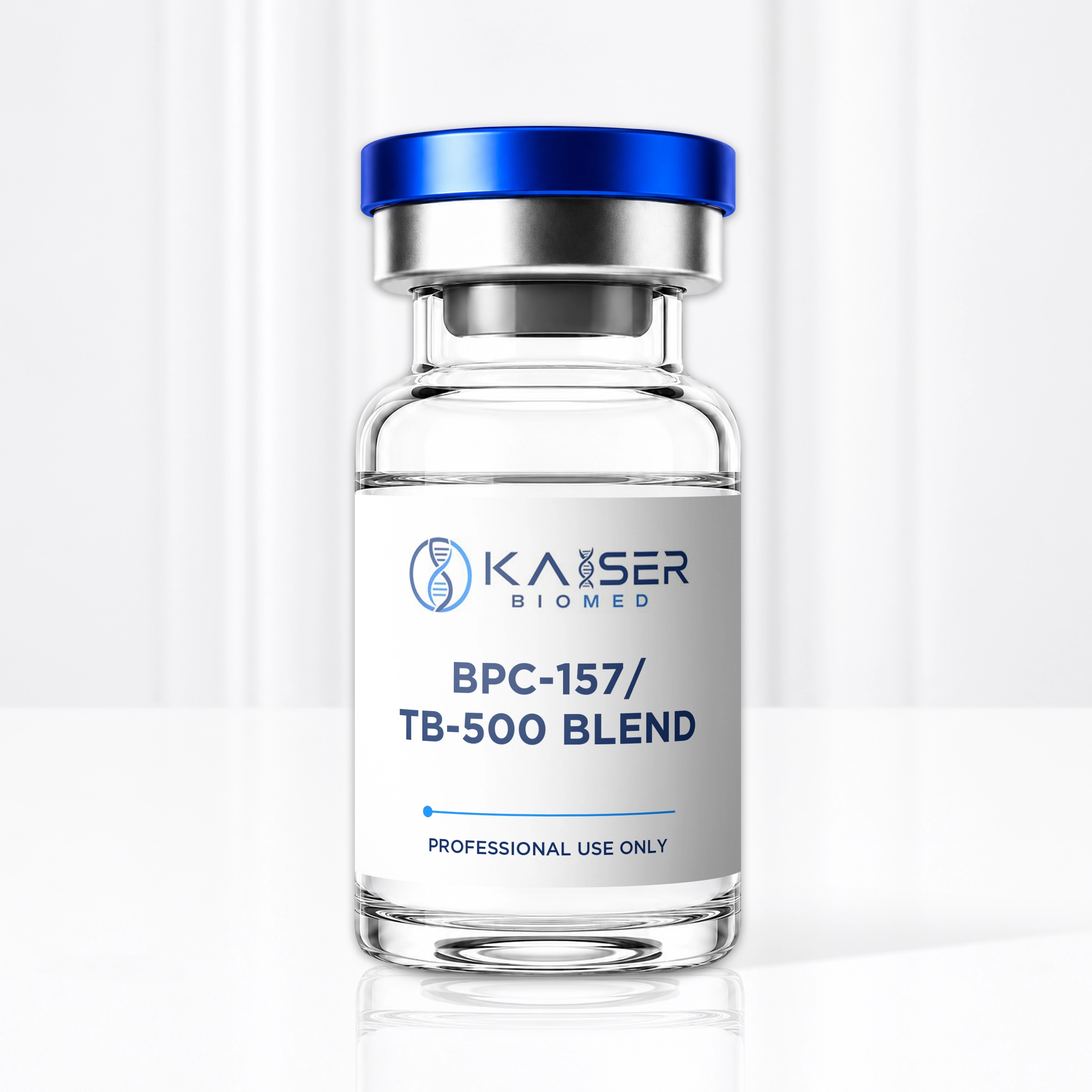
BPC-157 / TB-500 Blend (P-002/P-080/C-007/T-001; variable product; BPC-157 GEPPPGKPADDAGLV + TB-500 thymosin β4 LKKTETQ fragment; available as lyophilized vials, oral capsules, and transdermal gel) is a dual-peptide formulation pairing the complementary tissue-repair mechanisms of BPC-157 and TB-500. BPC-157 (pentadecapeptide, CAS 137525-51-0, MW 1419.53 g/mol) contributes VEGFR2-driven angiogenesis, bidirectional NO system modulation, and FAK-paxillin integrin pathway activation; TB-500 (the LKKTETQ actin-binding domain of thymosin β4) contributes G-actin sequestration, directional cell migration, and PINCH-ILK-Akt survival signaling. Together, these mechanisms address the full proliferative and vascular phases of connective tissue, musculoskeletal, and mucosal repair — making this blend one of the most widely referenced peptide combinations in the preclinical repair biology literature. Four formulations are available: lyophilized injectable (5+5 MG and 10+10 MG), oral capsules (500+500 MCG), and transdermal gel, enabling route-specific research protocols.
Clinical Indications
The BPC-157 / TB-500 combination addresses multiple tissue repair contexts investigated preclinically:
- Tendon and Ligament Repair: BPC-157’s FAK-paxillin fibroblast activation and TB-500’s actin-driven fibroblast migration combine to accelerate organized collagen fiber deposition in Achilles tendon transection and ACL injury models, producing measurably improved tensile strength recovery compared to either compound alone.
- Skeletal Muscle Repair and Cardiac Cytoprotection: TB-500/thymosin β4 activates PINCH-ILK-Akt survival pathways in cardiomyocytes and skeletal myocytes; BPC-157’s angiogenic activity restores perfusion to ischemic muscle tissue — together addressing both cellular survival and vascular re-establishment in muscle injury.
- Gastric and Intestinal Mucosal Healing: BPC-157’s original cytoprotective context (gastric mucosal protection against NSAID, ethanol, and stress injury) is augmented by TB-500’s cell migration properties in intestinal repair models, making the combination relevant to gastrointestinal mucosal regeneration contexts.
Contraindications
- Active Malignancy: Both BPC-157 (VEGFR2/NO) and TB-500 (thymosin β4 promotes endothelial survival) have pro-angiogenic and pro-proliferative properties; use in active oncological disease requires consideration of tumor vascularization risk.
- Transdermal Formulation Skin Sensitivity: The T-001 transdermal gel vehicle may contain permeation enhancers that can cause contact sensitization in individuals with compromised skin barrier or known skin hypersensitivity.
- Pregnancy: Neither component has been evaluated in pregnancy; pro-angiogenic and tissue-remodeling signals represent an incompletely characterized risk in the gestational context.
Mechanism of Action (MOA)
BPC-157 and TB-500 engage complementary non-redundant repair pathways, with documented synergistic amplification of repair outcomes:
BPC-157 — VEGFR2 Angiogenesis
BPC-157 (GEPPPGKPADDAGLV) upregulates vascular endothelial growth factor receptor 2 (VEGFR2) in endothelial cells, driving de novo capillary formation without requiring exogenous VEGF ligand — a receptor-level sensitization mechanism that makes BPC-157 angiogenically active even in growth-factor-depleted wound environments. This vascular effect directly counteracts the ischemic phase that limits healing speed.
TB-500 — G-Actin Sequestration and Directed Migration
TB-500 (thymosin β4 LKKTETQ fragment) binds monomeric G-actin in a 1:1 stoichiometric complex, maintaining a dynamic pool of unpolymerized actin that powers cytoskeletal remodeling and directional cell migration in fibroblasts, keratinocytes, and endothelial cells. This cytoskeletal regulation creates the cellular motility that closes wound defects and repopulates injured tissue.
Shared FAK-Paxillin and Integrin Signaling
Both BPC-157 and TB-500 converge on focal adhesion kinase–paxillin (FAK-paxillin) integrin signaling — BPC-157 via direct FAK-paxillin pathway activation, TB-500 via PINCH-ILK-Akt regulation. This shared downstream convergence amplifies fibroblast adhesion, proliferation, and collagen deposition beyond what either compound achieves alone in preclinical tendon repair models.
NO System Modulation and Anti-Inflammatory Activity
BPC-157 bidirectionally modulates the nitric oxide (NO) system, suppressing excessive NO-driven oxidative damage in inflammatory states while preserving vasodilatory NO in ischemic contexts. TB-500’s anti-inflammatory properties reduce neutrophil-mediated early wound damage. Together, these complementary anti-inflammatory mechanisms create an environment permissive for the proliferative repair phase driven by the VEGFR2 and actin-migration mechanisms.
Key Features & Specifications
Available in four delivery formulations for route-specific research protocols:
Chemical Analysis
| Property | Specification Reference Data |
|---|---|
| Component 1 — BPC-157 | GEPPPGKPADDAGLV (15 AA); CAS 137525-51-0; MW 1419.53 g/mol |
| Component 2 — TB-500 | Thymosin β4 LKKTETQ actin-binding domain fragment; MW ~887 g/mol (heptapeptide) |
| Form / Variation | 5+5 MG Lyophilized (P-002, $68) / 10+10 MG Lyophilized (P-080, $128) / 500+500 MCG Capsules (C-007, $134) / Transdermal Gel (T-001, $134) |
Storage, Safety, and Handling
Storage Protocol
Lyophilized formulations: store at −20 °C, protected from light and moisture; reconstitute with bacteriostatic water for injection using aseptic technique; reconstituted solution stable at 2–8 °C for up to 28 days. Capsule form: store at 15–25 °C in original sealed packaging. Transdermal gel: store at 2–8 °C and avoid freezing; close cap tightly after use; protect from heat and direct light.
Handling & Compliance
BPC-157 and TB-500/thymosin β4 are both listed under WADA S4 (Hormone and Metabolic Modulators); compliance obligations apply in competitive sports contexts. Handle with standard laboratory PPE. The transdermal gel formulation requires barrier protection (nitrile gloves) during application to prevent inadvertent systemic absorption by the researcher. Both components have pro-angiogenic properties; oncological research contexts require careful study design consideration.