
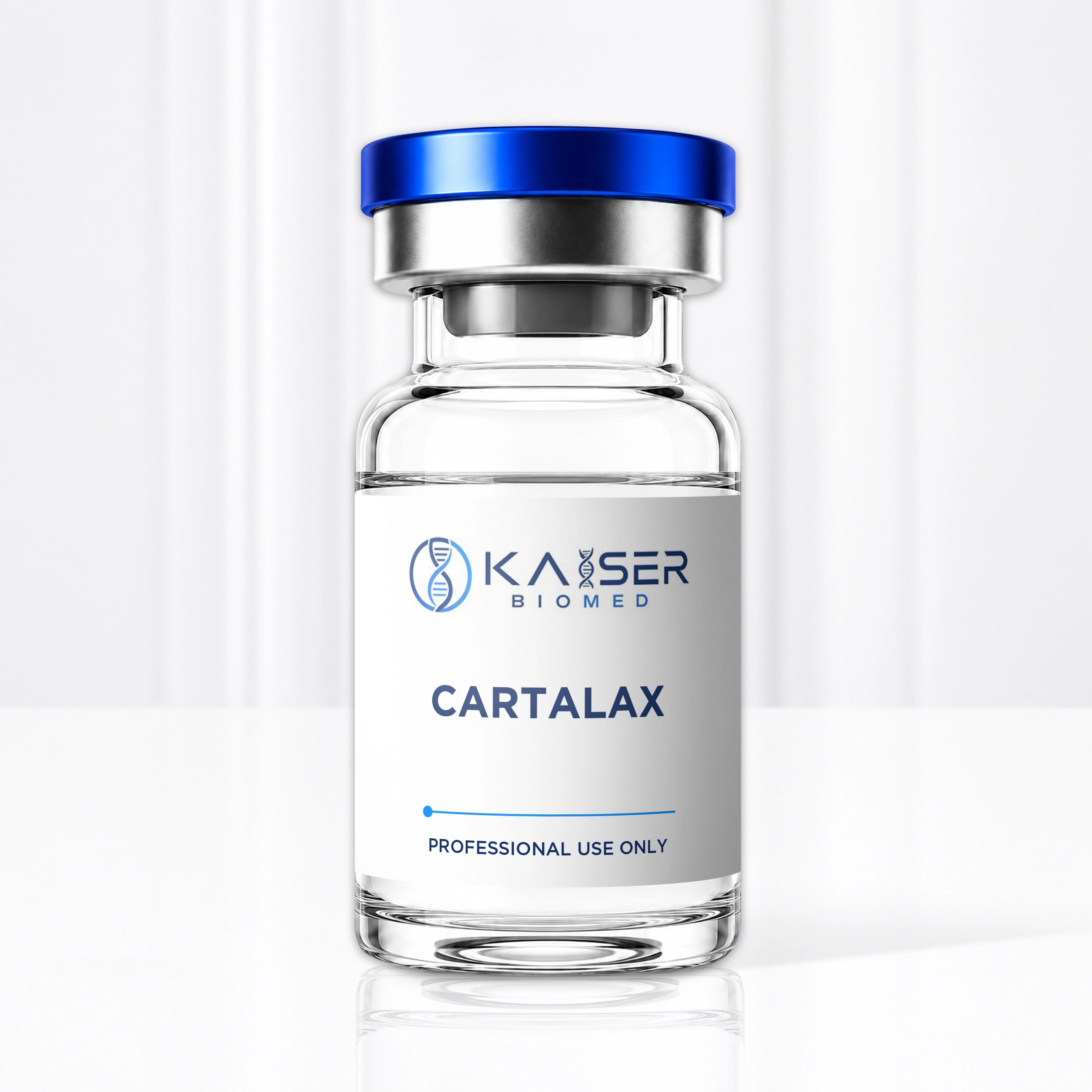
Description
Summary Abstract
Cartalax (Ala-Glu-Asp; AED; CAS 85806-95-7) is an ultrashort synthetic tripeptide bioregulator developed within the Khavinson peptide program at the Saint Petersburg Institute of Bioregulation and Gerontology. Its 333.29 Da molecular weight enables cellular and nuclear penetration without receptor-mediated transport; the two acidic residues (glutamate, aspartate) facilitate binding to the DNA minor groove at AT-rich sequences, specifically the d(ATATATATAT)2 motif. Through this epigenetic mechanism, Cartalax modulates transcription of genes governing cartilage extracellular matrix (ECM) synthesis and cellular senescence. Published in vitro data document suppression of senescence markers (p53, p16, p21), upregulation of the longevity deacetylase SIRT-6, inhibition of matrix metalloproteinase-9 (MMP-9), and enhancement of proliferation markers Ki-67 and CD98hc across murine fibroblast, renal epithelial, and bone marrow mesenchymal stem cell cultures.
Clinical Indications
Cartalax is investigated as a gene-regulatory tool compound with cartilage and connective tissue research applications:
- Cartilage ECM Modulation: Upregulates COL2A1 (collagen type II) mRNA by approximately 42% and ACAN (aggrecan) by approximately 38% in IL-1β-stressed human chondrocyte cultures, supporting osteoarthritis pathway studies.
- Cellular Senescence Research: Reduces expression of cyclin-dependent kinase inhibitors p16 and p21 and tumor suppressor p53 in aging fibroblast and renal cell models, providing a tool for senolytic and geroscience investigations.
- Genomic Stability Pathways: Upregulates SIRT-6, a NAD⁺-dependent deacetylase linked to DNA repair and telomere maintenance, making Cartalax useful in tankyrase/TNKS2 and longevity pathway studies.
Contraindications
- Hypothalamic-Pituitary-Gonadal Axis: Follistatin isoform FS-288 has high affinity for ovarian cells; studies employing peptide bioregulators alongside gonadal tissue models should include appropriate receptor control groups.
- Cell Proliferation Assays: The Ki-67 upregulation documented for Cartalax must be interpreted against appropriate passage-matched controls, as replicative senescence state significantly affects baseline proliferation markers.
- Conflation with Other Khavinson Peptides: Cartalax (AED) is tissue-specific for cartilage; its activity profile should not be extrapolated from Epithalon (AEDG), Pinealon (EDP), or other members of the bioregulator family without independent data.
Mechanism of Action (MOA)
Cartalax operates through direct nuclear entry and transcriptional regulation rather than classical cell-surface receptor signaling:
DNA Minor-Groove Binding
Molecular modeling and immunofluorescent confocal studies demonstrate that Cartalax forms energetically favorable complexes with d(ATATATATAT)2 sequences in the DNA minor groove. This direct binding enables chromatin remodeling at specific gene promoters without requiring receptor-mediated nuclear import.
Anabolic Gene Upregulation
In chondrocyte models, Cartalax increases expression of COL2A1 (collagen type II alpha-1 chain), ACAN (aggrecan), and SOX9 — the master transcription factor for cartilage ECM — while suppressing RUNX2-driven osteochondral differentiation. This shifts matrix metabolism toward the anabolic, chondroprotective phenotype.
Senescence Marker Suppression
Across fibroblast, renal epithelial, and bone marrow mesenchymal stem cell cultures, Cartalax reduces p53 (by up to 25%), p16, and p21 — cyclin-dependent kinase inhibitors that accumulate during replicative senescence — while increasing SIRT-6 and the regeneration glycoprotein CD98hc.
MMP-9 Inhibition and Apoptosis Reduction
Cartalax suppresses MMP-9 synthesis in aging fibroblasts, reducing excess ECM degradation, and inhibits caspase-3-dependent apoptosis, with reduced programmed cell death observed in both young and aged cell cultures. NF-κB pathway modulation has also been documented, though its net directionality requires further characterization.
Key Features & Specifications
Cartalax is a 20 mg lyophilized tripeptide bioregulator intended for cell biology and geroscience research applications:
Chemical Analysis
| Property | Specification Reference Data |
|---|---|
| Sequence | Ala-Glu-Asp (H-Ala-Glu-Asp-OH) |
| CAS Number | 85806-95-7 |
| Molecular Formula | C12H19N3O8 |
| Molecular Weight | 333.29 g/mol |
| PubChem CID | 87815447 |
| Synonyms | AED; alanyl-glutamyl-aspartic acid; AC-4/T-31; Cartalax |
| Form / Variation | 20 MG Lyophilized Powder (SKU P-064, $54.00) |
Storage, Safety, and Handling
Storage Protocol
Store lyophilized powder at −20 °C, protected from moisture. Upon reconstitution in sterile water or aqueous buffer, aliquot immediately and store at 2–8 °C for short-term use (up to 7 days) or at −80 °C for extended stability. Minimize freeze-thaw cycles to preserve peptide integrity.
Handling & Compliance
Handle with standard PPE. Cartalax is a synthetic peptide without approved pharmaceutical status in any jurisdiction. It is not listed as a prohibited substance under current WADA codes, but institutional research compliance review is recommended for any in vivo design. Published data originate primarily from the Khavinson group; independent replication in western laboratories remains limited.