
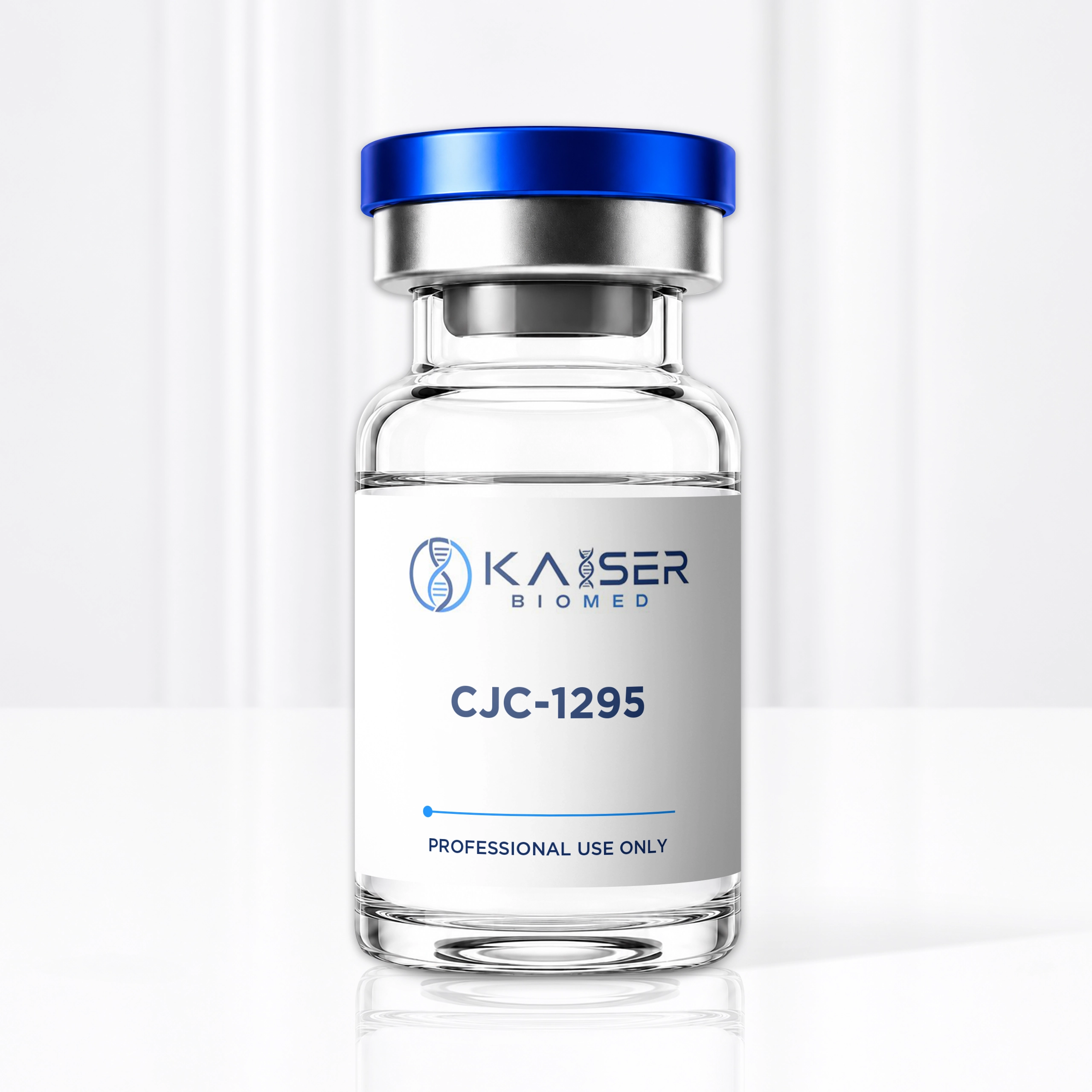
Description
Summary Abstract
CJC-1295 encompasses two pharmacologically distinct synthetic analogues of Growth Hormone-Releasing Hormone (GHRH) that share a tetrasubstituted 29-amino acid backbone but differ profoundly in their pharmacokinetic profiles. CJC-1295 without DAC (Modified GRF 1-29; Mod GRF 1-29) carries four amino acid substitutions at positions 2 (L-Ala → D-Ala), 8, 15, and 27 to resist Dipeptidyl Peptidase-4 (DPP-4) cleavage, achieving a half-life of approximately 30 minutes that produces discrete, physiologically pulsatile Growth Hormone (GH) bursts. CJC-1295 with DAC (DAC:GRF) incorporates an additional C-terminal lysine-maleimidopropionic acid (MPA) moiety — the Drug Affinity Complex (DAC) — that covalently binds free thiol groups on serum albumin, extending half-life to approximately 6–8 days and creating a sustained “GH bleed” superimposed on preserved endogenous GH pulses. Clinical data from Teichman et al. (2006) and Ionescu & Frohman (2006) in healthy adults demonstrated 2- to 10-fold increases in mean plasma GH sustained ≥6 days, 1.5- to 3-fold increases in IGF-1 for 9–11 days, and a 7.5-fold elevation in basal GH trough levels after a single dose of the DAC variant, with IGF-1 remaining elevated for up to 28 days after multiple doses. Both compounds activate GHRH receptors on pituitary somatotropes through the cAMP/PKA/CREB pathway, driving GH synthesis and secretion. CJC-1295 is listed as a prohibited substance under WADA Section S2 (Peptide Hormones, Growth Factors, and Related Substances).
Clinical Indications
Both variants activate the somatotropic axis, with applications driven by their distinct GH secretion patterns:
- Age-Related GH Decline / Somatopause: GHRH analogue studies (Corpas 1992, Khornam 1997) restored GH and IGF-1 to youthful levels in elderly men, improving lean mass, reducing fat mass, and increasing exercise tolerance.
- Body Composition — Lean Mass Accretion and Lipolysis: GH-driven anabolic effects on skeletal muscle protein synthesis and lipolytic effects on visceral adipose tissue are mediated by downstream IGF-1; the pulsatile profile of No DAC may preserve sex-specific anabolic signaling.
- Musculoskeletal Repair: GH and IGF-1 stimulate collagen synthesis, osteoblast activity, and chondrocyte proliferation; investigated in tissue repair, bone mineral density improvement, and connective tissue maintenance contexts.
- HIV-Associated Lipodystrophy (With DAC — Phase II): A Phase II trial was initiated for visceral obesity in HIV-positive patients before being halted; the mechanistic rationale (visceral fat lipolysis via GH) remains valid.
Contraindications
- Active or History of Malignancy: IGF-1 is a potent mitogen; chronic elevation carries theoretical risk of promoting occult or pre-existing neoplastic growth, particularly with the sustained IGF-1 elevation produced by the DAC variant.
- Diabetes or Insulin Resistance: GH is a counter-regulatory hormone to insulin; sustained GH/IGF-1 elevation (especially With DAC) can induce insulin resistance and impair glucose tolerance.
- Severe Cardiovascular Disease: Fluid retention, increased cardiac workload, and the cardiovascular event observed in the Phase II HIV lipodystrophy trial underscore the need for caution in patients with pre-existing cardiac comorbidities.
- Pregnancy: No safety data available; avoid use.
Mechanism of Action (MOA)
Both CJC-1295 variants act as agonists at the GHRH receptor (GHRH-R), a Class B G-protein-coupled receptor on pituitary somatotropes, but their distinct half-lives produce fundamentally different GH secretory dynamics:
GHRH Receptor Agonism — cAMP/PKA/CREB Cascade
Both variants bind the GHRH-R, activating Gαs to stimulate adenylyl cyclase and elevate intracellular cAMP. Protein Kinase A (PKA) activation leads to phosphorylation of the CREB transcription factor, initiating GH gene transcription and simultaneous release of stored GH granules via phospholipase C / calcium signaling.
Pulsatile GH Release — No DAC (Modified GRF 1-29)
The 30-minute half-life of CJC-1295 without DAC creates transient receptor stimulation followed by clearance, preserving the natural pulsatile GH secretory pattern. Physiological pulsatility is critical for GH-dependent hepatic gene expression and sex-specific anabolic signaling; this biomimetic approach may reduce the long-term endocrine risks associated with continuous receptor stimulation.
Sustained GH Elevation — With DAC (DAC:GRF)
The MPA moiety on CJC-1295 with DAC covalently binds the Cys-34 thiol of serum albumin, creating a circulating peptide-albumin complex with a 6–8 day effective half-life. This produces a continuous “GH bleed” — a markedly elevated basal GH trough — upon which natural pulses are superimposed. Ionescu & Frohman (2006) measured a 7.5-fold increase in basal GH and a 45% increase in mean IGF-1. The pharmacodynamic state resembles the hormonal environment of mild acromegaly, with corresponding long-term metabolic and cardiovascular risk considerations.
IGF-1 Mediated Downstream Anabolism
GH stimulates hepatic secretion of Insulin-Like Growth Factor-1 (IGF-1), which acts on muscle, bone, and connective tissue to promote amino acid uptake, protein synthesis, osteoblast activity, and collagen production. IGF-1 also drives lipolysis in adipose tissue through HSL activation, contributing to visceral fat reduction and improved body composition.
Key Features & Specifications
Distinguishing pharmacokinetic and structural parameters of the two CJC-1295 variants:
Chemical Analysis
| Property | Specification Reference Data |
|---|---|
| Sequence (No DAC) | Tyr-D-Ala-Asp-Ala-Ile-Phe-Thr-Gln-Ser-Tyr-Arg-Lys-Val-Leu-Gly-Gln-Leu-Ser-Ala-Arg-Lys-Leu-Leu-Gln-Asp-Ile-Met-Ser-Arg-NH₂ (29 AA; tetrasubstituted GRF 1-29) |
| CAS Number — No DAC | 863288-34-0 |
| CAS Number — With DAC | 863288-34-0 (same backbone); DAC conjugate CAS: 863288-35-1 |
| Molecular Weight — No DAC | ~3,367.9 g/mol |
| Molecular Weight — With DAC | ~3,647.3 g/mol (with MPA-Lys30 extension) |
| Synonyms (No DAC) | Modified GRF 1-29, Mod GRF 1-29, Tetrasubstituted GRF, CJC-1295 no DAC |
| Synonyms (With DAC) | CJC-1295, DAC:GRF, CJC-1295 DAC |
| Form / Variation | 2 MG Lyophilized No DAC (P-005) / 5 MG Lyophilized With DAC (P-006) |
Storage, Safety, and Handling
Storage Protocol
Store lyophilized peptide at −20 °C, protected from light and humidity. Reconstitute with bacteriostatic water for injection; stable at 2–8 °C for up to 14 days post-reconstitution. The No DAC variant is particularly sensitive to DPP-4 in reconstituted solutions; store at 4 °C and minimize the period between reconstitution and use. Avoid repeated freeze-thaw cycles.
Handling & Compliance
Handle under aseptic conditions using standard PPE. Both variants are classified as prohibited substances under WADA Section S2 (Peptide Hormones, Growth Factors, Related Substances, and Mimetics); use by competitive athletes is prohibited at all times. The FDA has proposed excluding CJC-1295 variants from the 503A compounding pharmacy Bulks List, citing immunogenicity and impurity concerns. Administration outside controlled settings and without appropriate monitoring of GH/IGF-1 levels is not recommended.