
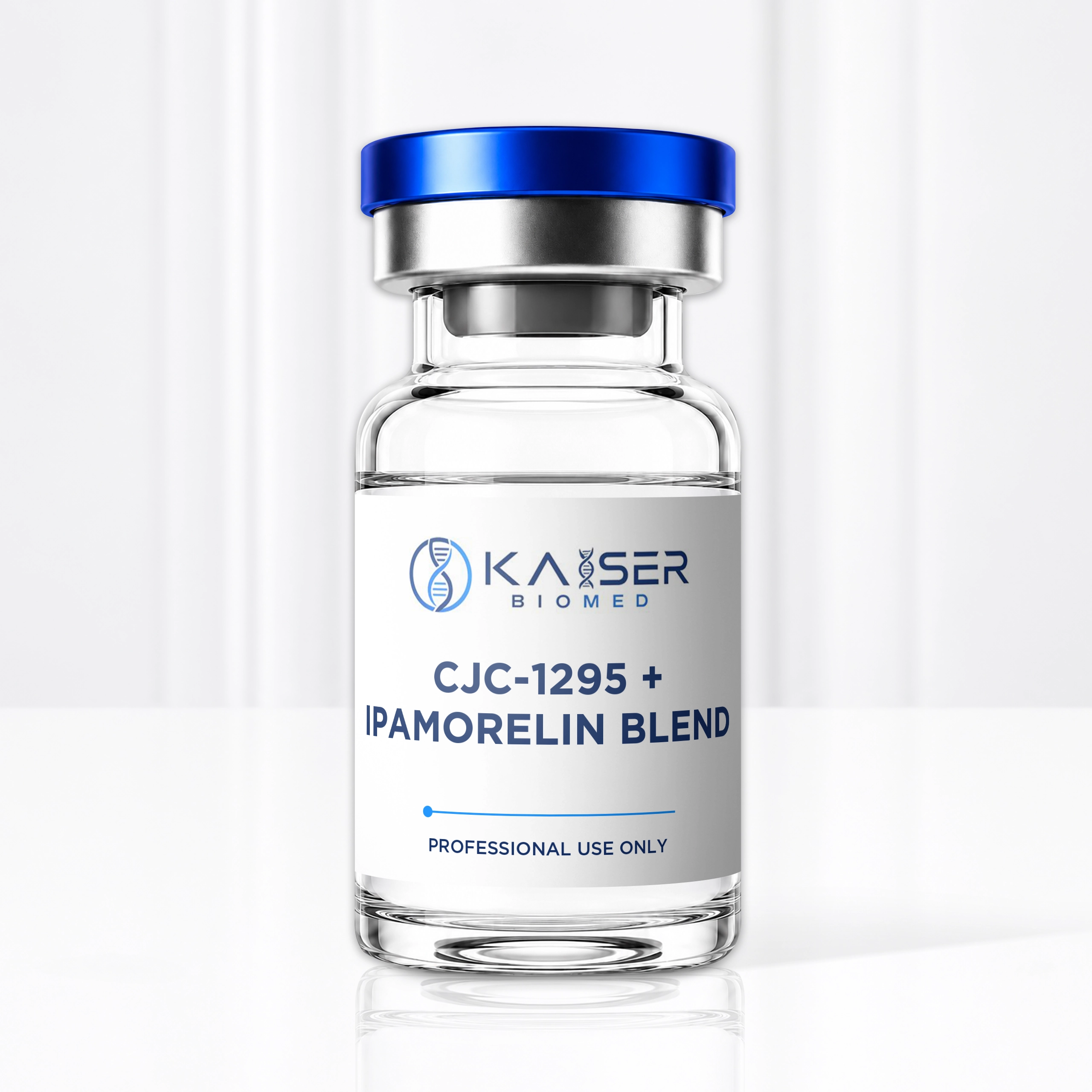
Description
Summary Abstract
CJC-1295 + Ipamorelin Blend (P-068 / P-083; variable product; GHRH analog + selective GHS-R1a pentapeptide agonist) combines two mechanistically complementary growth hormone (GH) secretagogues: CJC-1295, a 29-amino acid growth hormone-releasing hormone (GHRH) analog modified with a Drug Affinity Complex (DAC) that covalently binds serum albumin (via Cys34 thioether conjugation) to extend plasma half-life to 6–8 days; and Ipamorelin, a synthetic pentapeptide that selectively agonizes the growth hormone secretagogue receptor subtype 1a (GHS-R1a) — the ghrelin receptor on anterior pituitary somatotrophs — to amplify GH pulse amplitude without elevating cortisol, ACTH, or prolactin. Co-administration of a GHRH analog with a ghrelin-receptor agonist produces somatotroph stimulation at two independent receptor levels simultaneously, generating GH pulse amplitudes 2–5× greater than either compound alone in dose-escalation studies. A foundational 2006 Phase 1 trial by Teichman et al. (JCEM; PMID 16352683) confirmed that a single subcutaneous CJC-1295 injection produces 2–10-fold GH elevation for 6 or more days and 1.5–3-fold IGF-1 elevation for 9–11 days, underscoring the mechanistic rationale for once-weekly or bi-weekly dosing in research protocols.
Clinical Indications
The CJC-1295 + Ipamorelin combination targets the somatotropic axis across multiple research contexts:
- Growth Hormone Deficiency Research: CJC-1295 demonstrated normalization of growth and body composition in the GHRH-knockout mouse model with once-daily dosing; the combination with ipamorelin’s amplitude enhancement represents a research platform for studying GH axis restoration at physiologically relevant pulse frequencies.
- Body Composition and Anabolic Research: Sustained IGF-1 elevation (1.5–3-fold above baseline for 9–11 days per CJC-1295 dose) is associated with increased lean mass accrual and reduced adipogenesis in preclinical models; the ipamorelin component contributes GH amplitude amplification without the hyperinsulinemia or cortisol confound that complicates exogenous recombinant HGH protocols.
- Age-Related Somatotropic Axis Decline: GH pulse frequency and amplitude decline with age (somatopause); the GHRH+GHS-R1a dual-receptor strategy has been evaluated as a pharmacological approach to restoring physiological GH pulsatility in aging models without replacing the endogenous hypothalamic-pituitary feedback axis.
Contraindications
- Active Malignancy: GH and IGF-1 are potent mitogenic signals; sustained elevation via dual GH secretagogue therapy in individuals with active or latent malignancies (particularly GH/IGF-1 receptor-expressing tumors) is contraindicated pending oncological clearance.
- Acromegaly or History of GH-Secreting Adenoma: Pre-existing GH excess conditions are an absolute contraindication to GH secretagogue therapy of any class.
- Diabetic Retinopathy (Proliferative): IGF-1 elevation in the context of proliferative diabetic retinopathy may exacerbate neovascular pathology; ophthalmological assessment is indicated in relevant clinical contexts.
- Pregnancy: GH and IGF-1 axis stimulation during pregnancy presents an incompletely characterized risk profile; use is not established in gestational contexts.
Mechanism of Action (MOA)
CJC-1295 and Ipamorelin engage the GH secretory axis at two independent receptor systems, producing synergistic somatotroph stimulation:
CJC-1295 — GHRH Receptor Agonism with Extended Half-Life
CJC-1295 is a 29-amino acid analogue of growth hormone-releasing hormone (GHRH) incorporating four amino acid substitutions that confer resistance to dipeptidyl peptidase-4 (DPP-4) proteolysis, plus a C-terminal maleimidopropionic acid (MPA) linker that covalently bonds to Cys34 on circulating serum albumin after subcutaneous injection. The albumin conjugation extends the half-life from ~7 minutes (native GHRH) to 6–8 days, enabling prolonged GHRH receptor (GHRHR) occupancy on anterior pituitary somatotrophs and sustained elevation of GH and IGF-1 (Teichman et al., 2006; PMID 16352683).
Ipamorelin — Selective GHS-R1a Agonism
Ipamorelin is a synthetic pentapeptide (Aib-His-D-2-Nal-D-Phe-Lys-NH₂) that selectively agonizes the growth hormone secretagogue receptor subtype 1a (GHS-R1a) — the ghrelin receptor on somatotroph cells. Unlike earlier GHRP-class compounds (GHRP-2, GHRP-6), ipamorelin produces selective GH release without ACTH, cortisol, or prolactin elevation, as established in the Raun et al. (1998) swine study — a selectivity profile that makes it the benchmark GH secretagogue for protocols where HPA axis confound must be minimized.
Dual-Receptor Synergy — Amplitude and Duration
GHRH receptor agonism (CJC-1295) and GHS-R1a agonism (ipamorelin) operate through different intracellular pathways: GHRHR signals primarily via Gs/cAMP/PKA, while GHS-R1a signals via Gq/IP3/Ca²⁺. The simultaneous activation of both Gs and Gq pathways in somatotrophs produces a synergistic calcium-cAMP interaction that amplifies GH vesicle exocytosis, generating pulse amplitudes 2–5× greater than either compound alone — the mechanistic basis for the blend’s superiority over monotherapy at equivalent doses.
Physiological Pulsatility Preservation
Unlike exogenous recombinant human GH (rhGH), which suppresses endogenous pituitary output via negative feedback, the GHRH+GHS-R1a strategy stimulates the pituitary’s own secretory machinery, preserving the natural hypothalamic-pituitary feedback architecture. The somatostatin-mediated negative feedback circuit remains intact, ensuring that GH pulse intervals are maintained and that off-periods of GH secretion continue — a physiologically critical feature absent from continuous exogenous GH administration.
Key Features & Specifications
Defining pharmacological attributes of the CJC-1295 + Ipamorelin dual-secretagogue blend:
Chemical Analysis
| Property | Specification Reference Data |
|---|---|
| Component 1 — CJC-1295 | Modified GHRH(1-29) with 4 AA substitutions + C-terminal DAC (MPA-lysine) albumin-binding moiety; MW ~3647 Da (as synthesized); MW ~70 kDa as albumin conjugate; half-life ~6–8 days (human) |
| Component 2 — Ipamorelin | Aib-His-D-2-Nal-D-Phe-Lys-NH₂; synthetic pentapeptide; MW 711.87 g/mol; CAS 170851-70-4; selective GHS-R1a agonist |
| Form / Variation | 5 MG + 5 MG Lyophilized (P-083, $65) / 10 MG + 10 MG Lyophilized (P-068, $119) |
Storage, Safety, and Handling
Storage Protocol
Store lyophilized blend at −20 °C, protected from light and humidity. Reconstitute with bacteriostatic water for injection using aseptic technique, adding solvent slowly along the inner vial wall and swirling gently to dissolve. Reconstituted solution is stable at 2–8 °C for up to 28 days; avoid freeze-thaw cycling of the reconstituted preparation. CJC-1295’s albumin-binding chemistry is not affected by standard reconstitution procedures.
Handling & Compliance
CJC-1295 is classified under World Anti-Doping Agency (WADA) S2 (Peptide Hormones, Growth Factors, Related Substances); ipamorelin is similarly classified as a GHS-R1a agonist and subject to WADA S2 regulations. Both compounds are prohibited in competitive sports contexts. Handle with standard laboratory PPE under aseptic technique; GH axis stimulation carries dose-dependent risks of peripheral edema, carpal tunnel symptoms, and insulin resistance at supratherapeutic exposures.