
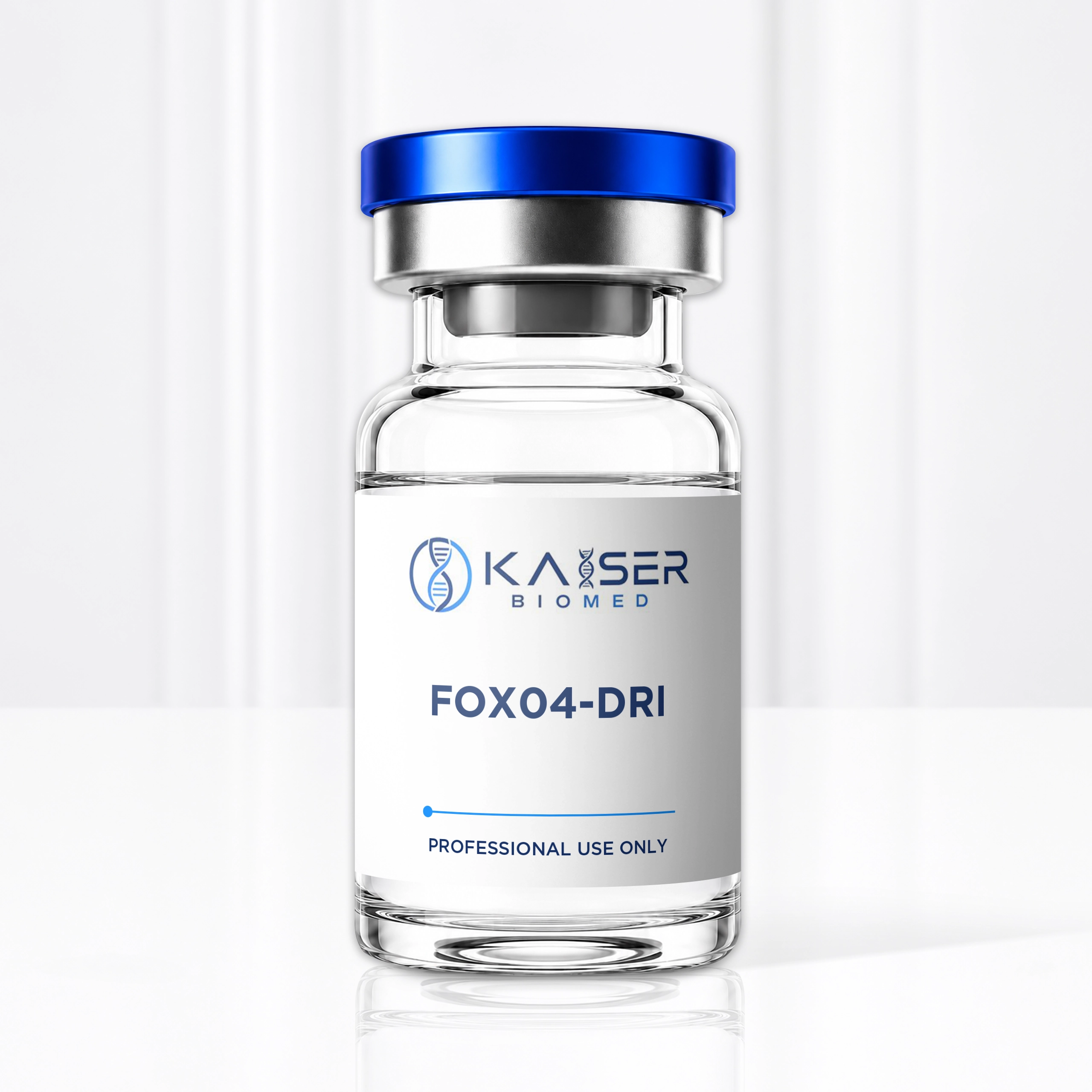
Description
Summary Abstract
FOXO4-DRI (Forkhead Box O4-D-Retro-Inverso peptide) is a rationally designed cell-penetrating peptide senolytic synthesized from D-amino acids in reversed sequence — a configuration that confers high proteolytic resistance while maintaining the three-dimensional binding geometry of the native FOXO4 protein. In senescent cells, FOXO4 translocates to the nucleus and physically sequesters activated p53 via its forkhead domain, preventing p53-mediated apoptosis and enabling pathological cellular persistence. FOXO4-DRI competitively disrupts this FOXO4–p53 interaction, liberating p53 to translocate to the mitochondria and initiate the intrinsic apoptotic cascade through caspase activation. Because FOXO4 is minimally expressed in most healthy non-senescent tissues, the resulting apoptosis is highly selective for the pathological “zombie” cell population. Murine preclinical studies demonstrate reversal of age-related frailty (2× running endurance, fur-density recovery), restoration of renal filtration biomarkers, normalization of plasma AST after doxorubicin-induced hepatotoxicity, selective clearance of senescent chondrocytes in ACI preparations, targeted apoptosis of senescent Leydig cells restoring serum testosterone, and reduced collagen deposition in bleomycin-induced pulmonary fibrosis. No formal human clinical trial data have been published to date.
Clinical Indications
Preclinical evidence positions FOXO4-DRI across senescence-driven pathologies:
- Systemic Aging and Frailty: Reversal of physical-activity decline, fur-density restoration, and behavioral activation in naturally aged and progeroid (XpdTTD/TTD) murine models following systemic administration.
- Chronic Kidney Disease (CKD): Significant reduction in plasma urea and creatinine in aged mice, consistent with restored glomerular filtration capacity after senescent-cell clearance.
- Chemotherapy-Induced Organ Damage: Normalization of doxorubicin-induced hepatic (AST) and renal (urea) toxicity markers, suggesting utility as an oncology adjuvant to mitigate treatment-related morbidity.
- Late-Onset Male Hypogonadism: Targeted apoptosis of senescent testicular Leydig cells restores serum testosterone levels in aged mice, with secondary improvements in spermatogenesis and sperm quality.
- Idiopathic Pulmonary Fibrosis: Reduced bleomycin-induced collagen deposition and ECM downregulation in a murine fibrosis model, presenting a potential therapeutic avenue for IPF.
Contraindications
- Active Wound Healing: Transient senescent cells orchestrate tissue repair; senolytic administration during acute wound healing may impair regenerative processes.
- Active Malignancy: Senescence functions as a tumor-suppression checkpoint; p53 pathway modulation carries theoretical oncogenic risk. Early data in TNBC suggests selective tumor-cell targeting but long-term risk in other malignancy contexts is undefined.
- Thrombocytopenia or Platelet Disorders: Rapid senescent-cell clearance may generate apoptotic body burden; monitoring of CBC and inflammatory markers is prudent.
- Pregnancy: Absence of gestational safety data; fetal developmental senescence roles preclude use.
Mechanism of Action (MOA)
FOXO4-DRI exploits a unique molecular vulnerability present exclusively in senescent cells, enabling highly selective targeted apoptosis:
FOXO4–p53 Axis Disruption
In senescent cells, FOXO4 translocates to the nucleus and physically binds activated p53 via its forkhead domain, sequestering the “guardian of the genome” and blocking its pro-apoptotic function. FOXO4-DRI mimics the p53-binding region of FOXO4 using D-amino acids in reversed sequence, competitively displacing endogenous FOXO4 from p53 without introducing novel toxic chemistry. This mechanism is limited by FOXO4 expression, which is upregulated specifically in senescent cells and essentially absent in healthy tissue.
p53 Liberation and Mitochondrial Apoptosis
Once freed from nuclear sequestration, active p53 undergoes nuclear exclusion and translocates to the mitochondria, where it initiates the intrinsic apoptotic pathway. The resulting caspase activation cascade systematically dismantles the senescent cell from within, producing an orderly, non-inflammatory cell death that allows the immune system to clear apoptotic bodies without triggering secondary SASP amplification.
D-Retro-Inverso Configuration — Stability & Selectivity
Synthesis from D-amino acids in a reversed sequence (retro-inverso) renders the peptide highly resistant to serine and cysteine proteases that rapidly degrade L-peptides in biological fluids. This dramatically extends in vivo bioavailability and ensures that the peptide reaches nuclear compartments of senescent cells at effective concentrations. The selectivity ceiling provided by differential FOXO4 expression limits off-target p53 modulation in non-senescent cells.
Key Features & Specifications
A first-in-class peptide senolytic with a rationally designed selectivity mechanism:
Chemical Analysis
| Property | Specification Reference Data |
|---|---|
| Sequence | D-retro-inverso peptide corresponding to FOXO4 p53-interaction domain (D-amino acid reversed sequence; proprietary synthesis based on FOXO4 forkhead region) |
| CAS Number | Not formally assigned in public registries (investigational compound) |
| Molecular Weight | ~4,800 Da (approximate; varies by batch and salt form) |
| PubChem CID | Not available (research-stage compound) |
| Synonyms | FOXO4-DRI, FOXO4-p53 senolytic peptide, D-retro-inverso FOXO4 |
| Form / Variation | 10 MG Lyophilized (SKU Fox) |
Storage, Safety, and Handling
Storage Protocol
Store lyophilized FOXO4-DRI at −20 °C or colder, protected from light and moisture. Upon reconstitution with sterile bacteriostatic water or PBS, aliquot immediately and store aliquots at −80 °C; avoid repeated freeze-thaw cycles. Use within the validated stability window provided on the certificate of analysis.
Handling & Compliance
Handle under aseptic conditions with standard PPE including gloves and eye protection. FOXO4-DRI modulates the p53 pathway — arguably the most consequential tumor suppressor in human biology — and all research protocols should include appropriate monitoring for off-target effects. Published murine data report no overt toxicity at therapeutic doses; extrapolation to human systems awaits formal Phase I trials. Handling, storage, and disposal should comply with institutional biosafety and waste-management guidelines.