
Description
Summary Abstract
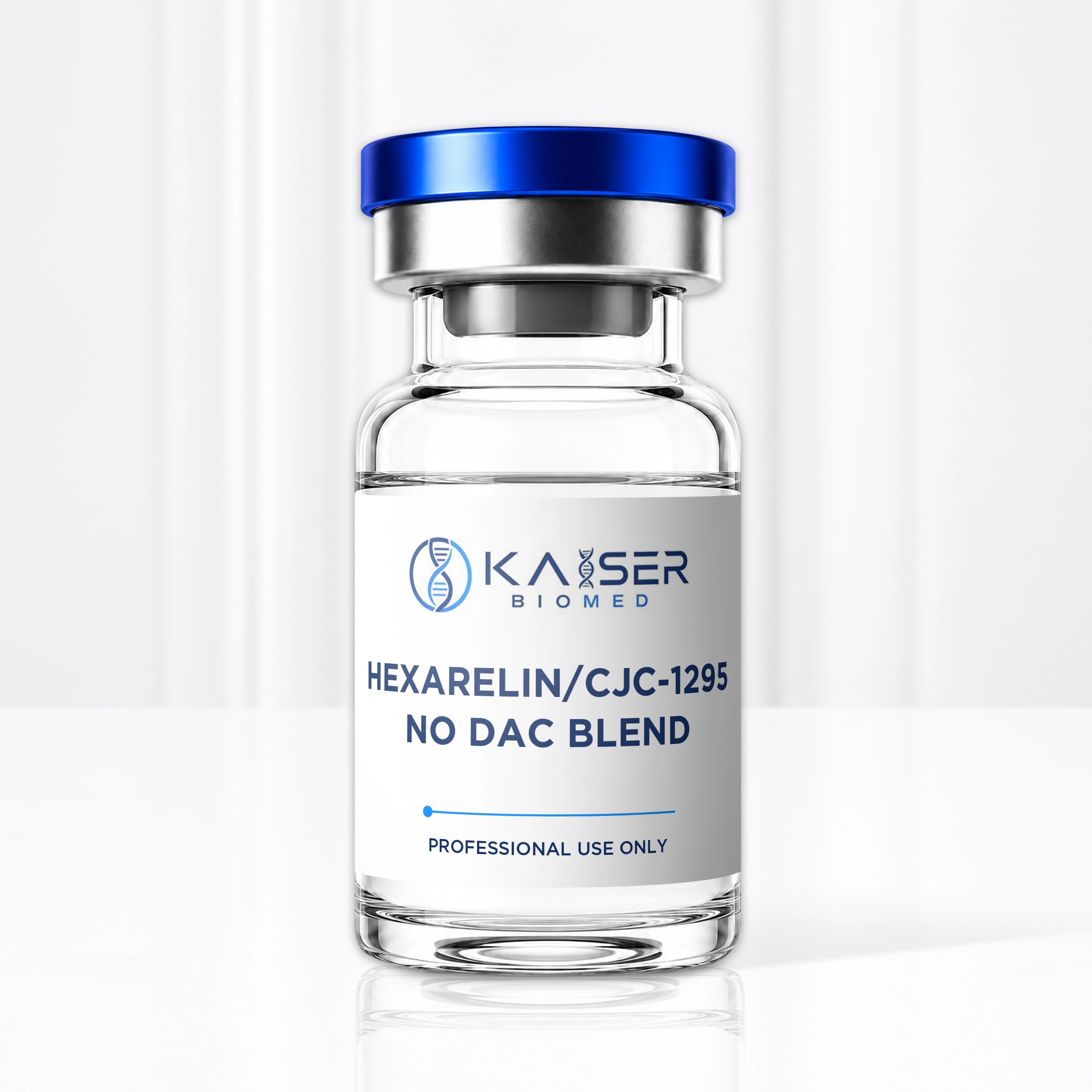
Hexarelin / CJC-1295 No DAC Blend (P-061; Hexarelin 7.5 MG + CJC-1295 No DAC 5 MG; 12.5 MG total lyophilized vial) combines the most potent synthetic Growth Hormone Releasing Peptide (GHRP) with a DPP-4-resistant Growth Hormone-Releasing Hormone (GHRH) analog to engage two entirely separate intracellular signaling cascades at the pituitary somatotroph simultaneously. Hexarelin (His-D-2-MeTrp-Ala-Trp-D-Phe-Lys-NH₂; Examorelin; CAS 140703-51-1; MW 887.05 g/mol) activates the ghrelin receptor GHS-R1a via the Gαq/11-PLC-IP3-Ca²⁺ pathway, producing the highest GH pulse amplitude of any synthetic secretagogue documented in human studies. CJC-1295 No DAC (Modified GRF 1-29; Mod GRF; Sermorelin tetrasubstituted; CAS 863288-34-0; MW ~3,367 g/mol) is a 29-amino acid GHRH analog with four stabilizing substitutions (D-Ala², Gln⁸, Ala¹⁵, Leu²⁷) that confer DPP-4 resistance while retaining the ~30-minute pulsatile half-life that closely mirrors physiological GHRH secretion; it signals through the GHRH receptor via the Gs-cAMP-PKA pathway. Because these two mechanisms — calcium-dependent (GHRP) and cAMP-dependent (GHRH) — converge at the somatotroph through independent second messenger systems, their co-administration produces a synergistic GH response substantially exceeding either compound alone. Hexarelin further engages the CD36 scavenger receptor on cardiac myocytes, conferring cardioprotective effects independent of GH release — a unique property not shared by any other GHRP in clinical research.
Clinical Research Indications
Pulsatile GH-axis amplification research spans multiple physiological domains:
- Growth Hormone Deficiency (GHD) Diagnostic Models: Hexarelin’s potent GHS-R1a agonism has been used as a provocation agent to assess pituitary somatotroph reserve, distinguishing hypothalamic from pituitary GHD; co-administration with a GHRH analog maximizes provocation sensitivity.
- Body Composition and Lean Mass: GH and downstream IGF-1 elevation drives lipolysis, muscle protein synthesis, and lean mass accretion; the synergistic GH response from dual-pathway stimulation is hypothesized to amplify these anabolic and lipolytic effects.
- Cardioprotection (Hexarelin-Specific, GH-Independent): Hexarelin’s CD36 scavenger receptor engagement on cardiomyocytes activates PI3K/Akt signaling, reducing ischemia-reperfusion injury and apoptosis through a pathway confirmed in GHS-R1a knockout models — unrelated to GH release.
- Pulsatile GH Secretion Research: CJC-1295 No DAC’s short (~30-minute) half-life enables pulsatile GH release patterns that more closely resemble physiological secretion compared to long-acting DAC variants, making this blend preferred for research designs requiring natural GH pulse kinetics.
Contraindications
- Active Neoplasia: GH and IGF-1 elevation can promote growth of IGF-1R-expressing tumors; use in subjects with active or suspected malignancy requires specialized oversight.
- Acromegaly / Elevated Baseline IGF-1: Supra-physiological GH/IGF-1 induction in individuals with pre-existing GH excess may worsen acromegalic features, glucose intolerance, and soft-tissue overgrowth.
- Tachyphylaxis Monitoring: Hexarelin undergoes receptor desensitization (GHS-R1a internalization) after 4–8 weeks of continuous use, requiring cycling protocols; research designs should account for diminished GH response amplitude over time.
- Cortisol and Prolactin Elevation (Hexarelin-Specific): Unlike ipamorelin, hexarelin stimulates CRH-mediated ACTH/cortisol and dopaminergic prolactin release at higher doses; protocols sensitive to HPA axis perturbation should use lower doses or substitute a more selective GHRP.
Mechanism of Action (MOA)
This blend activates two independent GH-stimulatory pathways at the somatotroph, plus a GH-independent cardioprotective pathway unique to Hexarelin:
Hexarelin — GHS-R1a Agonism (Gαq/11 / Ca²⁺ Pathway)
Hexarelin binds the ghrelin receptor (GHS-R1a) with extremely high affinity (Ki ~0.1–0.3 nM), the highest among synthetic GHRPs. Receptor engagement couples through Gαq/11 → phospholipase C-β (PLCβ) → IP3 → Ca²⁺ release from endoplasmic reticulum stores, driving rapid GH vesicle exocytosis from anterior pituitary somatotrophs. Peak GH concentrations of 40–120 ng/mL have been documented 15–45 minutes post-administration in clinical studies — 20–30% greater than GHRP-2 at equivalent doses. The D-2-methyltryptophan substitution at position 2 confers enhanced binding affinity and proteolytic resistance versus earlier GHRPs.
CJC-1295 No DAC — GHRH-R Agonism (Gs / cAMP / PKA Pathway)
CJC-1295 No DAC (Modified GRF 1-29) binds the GHRH receptor (GHRH-R) — a Class B GPCR on pituitary somatotrophs — and couples through Gs → adenylyl cyclase → cAMP → PKA → CREB phosphorylation and voltage-dependent Ca²⁺ influx to trigger GH exocytosis. Four stabilizing substitutions (D-Ala², Gln⁸, Ala¹⁵, Leu²⁷) confer DPP-4 resistance, extending the effective half-life to ~30 minutes versus ~7 minutes for native GHRH(1-29). Downstream, PKA-driven GH gene transcription (via Pit-1) augments GH biosynthesis in addition to acute secretion.
Synergistic Dual-Pathway Amplification
The Ca²⁺-dependent (GHS-R1a via Hexarelin) and cAMP-dependent (GHRH-R via CJC-1295 No DAC) pathways converge at independent second-messenger cascades within the same somatotroph cell. Research in pituitary models documents a synergistic GH response when both are co-administered — substantially greater than the sum of either alone — because neither pathway desensitizes the other’s receptor. CJC-1295 No DAC additionally counteracts somatostatin-mediated inhibition through its GHRH-R signaling, further amplifying the net GH secretory response to Hexarelin’s direct stimulation.
Hexarelin — CD36 Receptor Agonism: GH-Independent Cardioprotection
Hexarelin binds the CD36 scavenger receptor on cardiac myocytes, macrophages, and endothelial cells at the Asn132–Glu177 domain (Ki ~2.1 nM). CD36 engagement activates the PI3K/Akt pathway, phosphorylating BAD protein to prevent mitochondrial cytochrome c release and apoptosis cascade initiation during ischemic stress. In GHS-R1a knockout mouse studies, hexarelin reduced myocardial infarct size by 40–55% exclusively through this CD36-mediated mechanism. This cardioprotective pathway — unique among all synthetic GHRPs — also reduces TNF-α/IL-6 expression and improves eNOS activity independent of the endocrine GH-IGF-1 axis.
Key Features & Specifications
Pharmacological and structural attributes that define this pulsatile GH-amplification blend:
Chemical Analysis
| Property | Specification Reference Data |
|---|---|
| Component 1 — Hexarelin | Synthetic hexapeptide GHRP; His-D-2-MeTrp-Ala-Trp-D-Phe-Lys-NH₂ (6 AA; C-terminal amide; D-2-methyltryptophan at position 2) |
| Hexarelin CAS | 140703-51-1 |
| Hexarelin Molecular Formula | C47H58N12O6 |
| Hexarelin Molecular Weight | 887.05 g/mol |
| Hexarelin Synonyms | Examorelin; Hexarelin Acetate; EP 23905 |
| Hexarelin Half-Life | ~70 minutes (subcutaneous) |
| Component 2 — CJC-1295 No DAC | Modified GRF 1-29; 29 AA GHRH analog; Tyr-D-Ala-Asp-Ala-Ile-Phe-Thr-Gln-Ser-Tyr-Arg-Lys-Val-Leu-Ala-Gln-Leu-Ser-Ala-Arg-Lys-Leu-Leu-Gln-Asp-Ile-Leu-Ser-Arg-NH₂ (4 substitutions: D-Ala², Gln⁸, Ala¹⁵, Leu²⁷) |
| CJC-1295 No DAC CAS | 863288-34-0 |
| CJC-1295 No DAC Molecular Formula | C152H252N44O42 |
| CJC-1295 No DAC Molecular Weight | ~3,367 g/mol |
| CJC-1295 No DAC Synonyms | Modified GRF 1-29; Mod GRF(1-29); Sermorelin tetrasubstituted; GRF analog |
| CJC-1295 No DAC Half-Life | ~30 minutes (pulsatile; no albumin binding) |
| Form / Variation | 12.5 MG Lyophilized Blend Vial (P-061) — 7.5 MG Hexarelin + 5 MG CJC-1295 No DAC |
Storage, Safety, and Handling
Storage Protocol
Store lyophilized powder at −20 °C, protected from light; avoid humidity exposure during storage. Once reconstituted with bacteriostatic water for injection, store the solution at 2–8 °C and use within 28 days; avoid freeze-thaw cycling. CJC-1295 No DAC is relatively stable in aqueous solution; Hexarelin’s aromatic residues (Trp, D-2-MeTrp) are susceptible to oxidation under UV exposure — keep all solutions amber-shielded.
Handling & Compliance
Handle with standard laboratory PPE (nitrile gloves, safety glasses) and aseptic technique. Both components are potent GH-axis activators; research protocols should account for cortisol and prolactin co-stimulation from hexarelin at higher doses (not seen with ipamorelin-based blends). Both Hexarelin and CJC-1295 are classified as prohibited substances under WADA S2 Peptide Hormones, Growth Factors, Related Substances and Mimetics. Tachyphylaxis protocols should include off-cycle periods every 4–8 weeks for sustained-response research designs.