
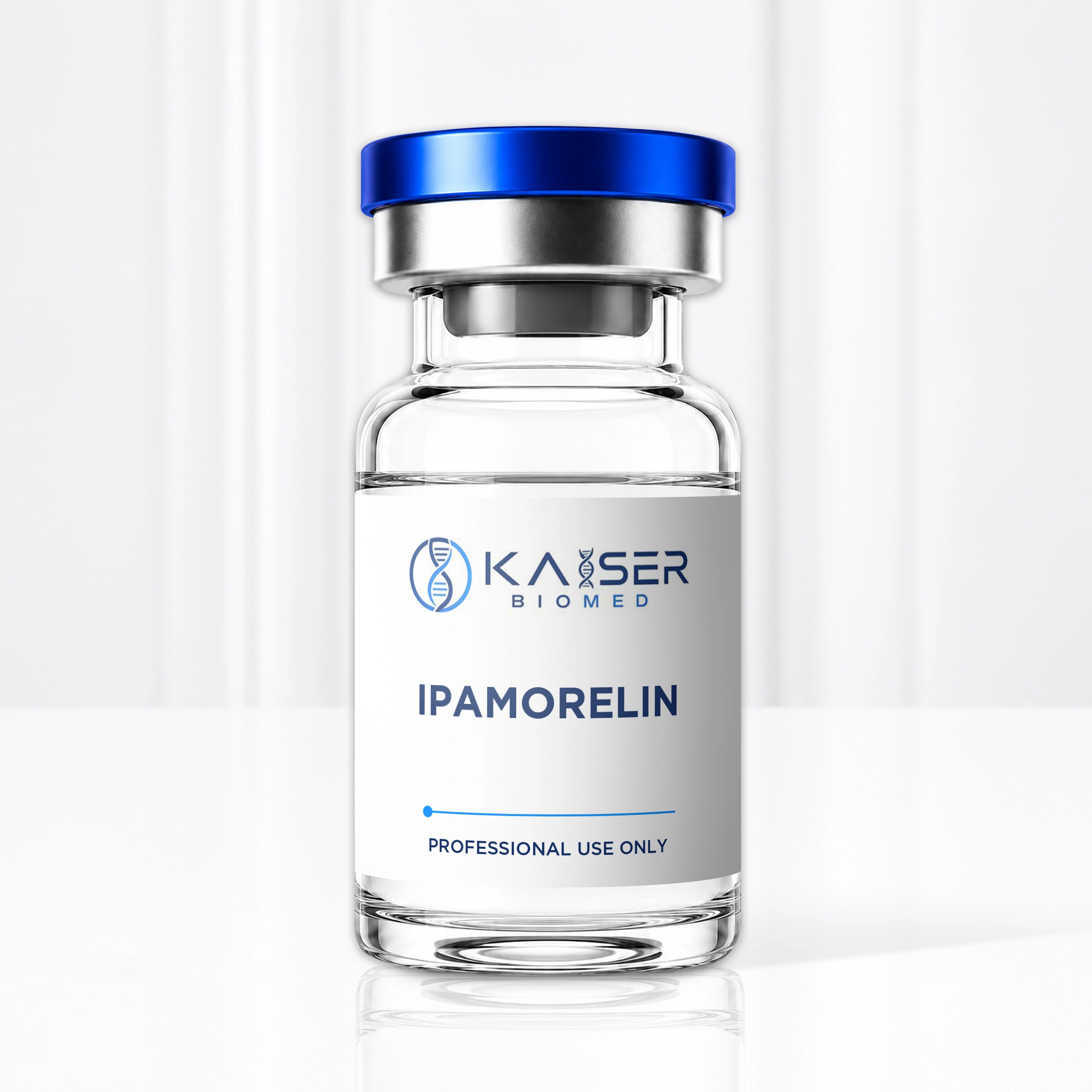
Description
Summary Abstract
Ipamorelin (NNC 26-0161; IPAM) is a synthetic pentapeptide growth hormone secretagogue (GHS) with the sequence Aib-His-D-2-Nal-D-Phe-Lys-NH2, designed as a third-generation ghrelin receptor agonist to maximize selectivity for the growth hormone secretagogue receptor type 1a (GHSR-1a) while eliminating off-target ACTH, cortisol, and prolactin stimulation seen with earlier GHS compounds such as GHRP-2 and GHRP-6. Developed by Novo Nordisk and licensed to Helsinn Therapeutics for clinical development, ipamorelin demonstrates over 40,000-fold selectivity for GHSR-1a over corticotropin-releasing hormone receptors, producing clean GH stimulation without HPA axis activation at doses up to 200× the pituitary ED50. The D-amino acid residues at positions 3 and 4 confer protease resistance, improving plasma stability versus all-L-amino acid sequences. It is prohibited under WADA S2 and subject to FDA 503B compounding restrictions.
Clinical Indications
Ipamorelin has been evaluated across GH axis pharmacology, GI motility, bone biology, and anti-catabolic research:
- GH Axis Pharmacology Reference: Ipamorelin is the benchmark GHSR-1a selectivity compound; its clean cortisol/prolactin profile enables GH-selective research without confounding HPA axis activation.
- Postoperative Ileus (POI): Phase II RCT (NCT00672074, n=117) showed 25.3h vs 32.6h to first solid food (p=0.15) — primary endpoint not met; dataset provides mechanistic human data on enteric GHSR-1a signaling and GI motility.
- Bone Mineral Research: Preclinical data demonstrate ipamorelin increases tibial and vertebral bone mineral content via appositional (periosteal) growth, distinguishing its skeletal profile from bisphosphonates and PTH analogs.
- Glucocorticoid-Induced Catabolism: Ipamorelin counteracted glucocorticoid-induced muscle wasting in rat models, supporting investigation in corticosteroid-associated catabolism research contexts.
Contraindications
- IV Route (FDA Safety Concern): FDA review of the intravenous ipamorelin clinical program noted immunogenicity risk and serious adverse events including deaths attributed to the IV route and patient population; IV administration requires careful risk-benefit assessment and protocol review.
- WADA-Governed Athletics: Prohibited under WADA S2 (Peptide Hormones, Growth Factors, and Related Substances), in- and out-of-competition; incompatible with competitive athletics under WADA code.
- Chronic Administration & Adipogenic Signaling: GH-independent GHSR-1a-mediated adipogenic signaling may increase fat mass in chronic administration protocols, independent of GH-axis lipolytic effects; study designs should anticipate this when interpreting body composition endpoints.
Mechanism of Action (MOA)
Ipamorelin acts as a selective agonist at GHSR-1a expressed on pituitary somatotrophs, hypothalamic neurons, GI smooth muscle, and bone, activating multiple downstream pathways:
GHSR-1a → Pulsatile GH Release
GHSR-1a activation by ipamorelin stimulates GH secretion via PLC/IP3/PKC signaling, raising intracellular calcium in somatotrophs. Ipamorelin acts synergistically with endogenous GHRH, amplifying pulsatile GH peaks without elevating inter-pulse baseline. At 200× the pituitary ED50, it produces no ACTH/cortisol or prolactin stimulation — the defining selectivity advantage over GHRP-2 and GHRP-6.
GI Motility & Enteric GHSR-1a
GHSR-1a is expressed on enteric neurons and GI smooth muscle; ghrelin receptor agonism accelerates gastric emptying and intestinal transit. This is the physiological basis for ipamorelin’s POI clinical development. The mechanistic dataset from Phase II — despite missing statistical significance — confirms that enteric GHSR-1a signaling modulates GI transit in human subjects.
Bone Mineralization & Periosteal Growth
GHSR-1a expressed on osteoblasts mediates GH/IGF-1-driven periosteal bone formation. Ipamorelin increases bone mineral content (BMC) in the tibia and vertebrae through appositional (periosteal) growth — increased bone width/thickness rather than density. This mechanism is distinct from anti-resorptive bisphosphonates or trabecular PTH analog effects.
Key Features & Specifications
Ipamorelin’s clean selectivity profile and D-amino acid protease resistance make it the preferred reference compound for GHSR-1a pharmacology research:
Chemical Analysis
| Property | Specification Reference Data |
|---|---|
| Sequence | Aib-His-D-2-Nal-D-Phe-Lys-NH2 (Aib = α-aminoisobutyric acid; D-2-Nal = D-2-naphthylalanine) |
| CAS Number | 170851-70-4 |
| Molecular Formula | C38H49N9O5 |
| Molecular Weight | 711.86 g/mol |
| PubChem CID | 9831659 |
| Synonyms | Ipamorelin; NNC 26-0161; IPAM; growth hormone secretagogue GHSR-1a agonist pentapeptide |
| Form / Variation | 5 MG Lyophilized (P-021) / 10 MG Lyophilized (P-058) |
Storage, Safety, and Handling
Storage Protocol
Store lyophilized ipamorelin at −20°C, protected from light; avoid freeze-thaw cycles. Reconstituted solution should be refrigerated at 2–8°C and used within 14 days; do not freeze after reconstitution. Reconstitute with bacteriostatic water or sterile water for injection by gently swirling to dissolve. The D-amino acid residues (D-2-Nal, D-Phe) at positions 3 and 4 confer excellent protease resistance, improving peptide stability in solution relative to all-L-amino acid sequences of comparable size.
Handling & Compliance
Prepare reconstituted solutions under sterile technique with gloves and appropriate PPE. Subcutaneous administration is preferred; IV use carries FDA-noted immunogenicity risk and documented serious adverse events from the Helsinn clinical program. Ipamorelin is prohibited under WADA S2 in- and out-of-competition. It is subject to FDA restrictions on bulk GHS peptide compounding at 503B outsourcing facilities. The absence of ACTH/cortisol stimulation at pharmacological doses reduces HPA axis suppression concerns associated with earlier GHS compounds.