
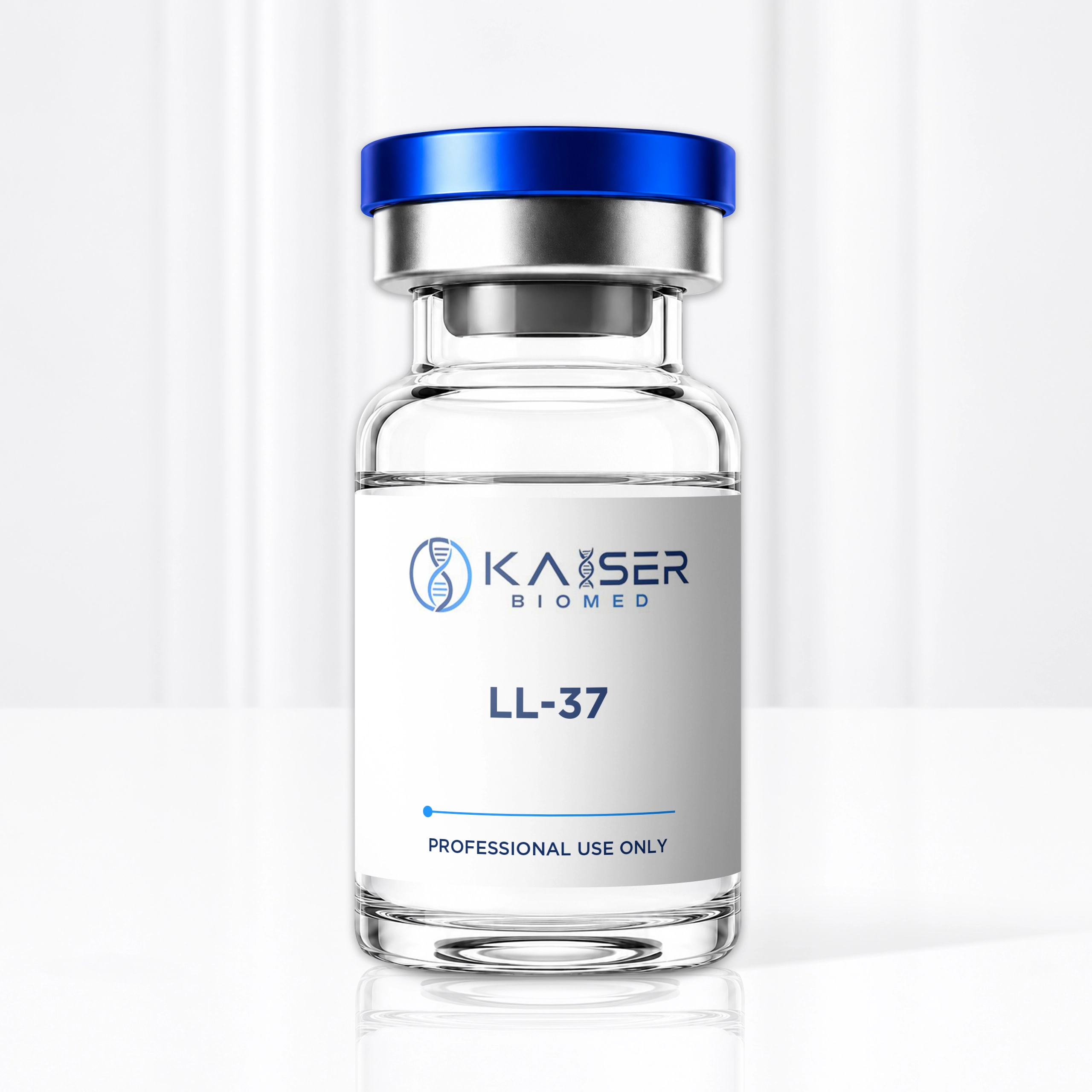
Description
Summary Abstract
LL-37 (human cathelicidin; sequence NH2-LLGDFFRKSKEKIGKEFKRIVQRIKDFLRNLVPRTES-COOH; MW ~4,493 Da; 37 amino acids; net charge +6 at physiological pH) is the sole processed product of the human CAMP gene and the only cathelicidin family member in humans. Derived from the precursor protein hCAP18 by cell-type-specific proteolytic cleavage (proteinase 3 in neutrophils; kallikrein-5/7 in keratinocytes), LL-37 constitutes a multifunctional alarmin of the innate immune system. Its amphipathic α-helical structure (residues 2–31, helix-bend-helix motif) enables electrostatic interaction with anionic microbial surfaces followed by membrane disruption via toroidal-pore or carpet mechanisms, conferring potent activity against Gram-positive and Gram-negative bacteria — including MDR strains — fungi (Candida albicans), and enveloped viruses (IAV, RSV, HIV, SARS-CoV-2). Beyond direct microbicidal action, LL-37 engages FPRL1/FPR2, P2X7, and EGFR receptors, activating PI3K/AKT, MAPK, and NF-κB cascades that govern chemotaxis, angiogenesis, keratinocyte proliferation, and wound closure. A landmark randomized, placebo-controlled trial demonstrated six-fold higher healing-rate constants at 0.5 mg/mL in venous leg ulcers; a separate RCT confirmed enhanced granulation-index improvement in diabetic foot ulcers.
Clinical Indications
LL-37’s multi-receptor engagement drives investigation across infectious, wound, and regenerative contexts:
- Chronic Wound Healing (Venous Leg / Diabetic Foot Ulcers): RCT-validated: 0.5 mg/mL topical LL-37 produced ~6× higher healing-rate constants vs. placebo in VLUs; diabetic foot ulcer trial confirmed superior granulation-index increase over 4 weeks.
- Multidrug-Resistant (MDR) Bacterial Infections: Direct membrane disruption active against MRSA, MDR Pseudomonas aeruginosa, and colistin-resistant Gram-negatives; anti-biofilm activity relevant to device-associated and chronic infections.
- Angiogenesis and Ischemic Tissue Repair: In a rabbit hind-limb ischemia model, LL-37 increased capillary density (angiogenesis) and collateral-vessel development (arteriogenesis) via FPRL1-dependent PI3K/AKT signaling, independent of VEGF.
- Antiviral Host Defense: Virucidal activity against enveloped viruses via envelope disruption and receptor-masking (e.g., ACE2 masking against SARS-CoV-2 S1 domain); nitric-oxide-synthase inhibition addresses viral-cytokine-induced mitochondrial blockade.
Contraindications
- Psoriasis or Active Autoimmune Skin Disease: LL-37 overexpression drives the psoriatic self-DNA/TLR9 inflammatory cycle; exogenous addition in active psoriasis may exacerbate the autoimmune cascade.
- Systemic Lupus Erythematosus (SLE): LL-37 complexes with self-nucleic acids and acts as an autoantigen in SLE; systemic administration is contraindicated.
- G6PD Deficiency (Hemolysis Risk): At cytotoxic concentrations, LL-37 permeabilizes red-blood-cell membranes; G6PD-deficient patients may face heightened hemolytic risk.
- Active Malignancy with Pro-Tumorigenic c-Met/EGFR Expression: In ovarian, lung, and breast cancers LL-37 can function as an autocrine growth factor via EGFR transactivation; use in these malignancy contexts requires caution.
Mechanism of Action (MOA)
LL-37 operates via two principal and interconnected modes: direct membrane disruption and receptor-mediated immunomodulation:
Amphipathic Membrane Disruption
In membrane-mimetic environments, LL-37 adopts an amphipathic α-helical conformation segregating hydrophobic and hydrophilic faces. Electrostatic attraction to anionic microbial surfaces (LPS, lipoteichoic acid, anionic phospholipids) positions the peptide for insertion of its hydrophobic face into the bilayer. Toroidal-pore and carpet mechanisms then permeabilize the membrane, disrupting ionic gradients and inducing cell lysis. This physical mechanism is target-agnostic, making resistance evolution substantially more difficult than for enzyme-targeted antibiotics.
FPRL1 / EGFR / P2X7 Receptor Signaling
LL-37 engages FPRL1/FPR2 (G-protein coupled receptor) on phagocytes and endothelial cells, driving neutrophil and monocyte chemotaxis plus VEGF-independent angiogenesis via PI3K/AKT and MAPK/ERK. Transactivation of EGFR promotes keratinocyte proliferation and migration for re-epithelialization. P2X7 receptor engagement modulates neutrophil apoptosis, autophagy induction, and macrophage cytokine release, fine-tuning the inflammatory response.
TLR Modulation — Dual Inflammatory Regulator
LL-37 binds and neutralizes LPS, preventing TLR4 activation and dampening endotoxin-mediated inflammation. Conversely, LL-37–self-nucleic-acid complexes are taken up by plasmacytoid dendritic cells and potently activate TLR9/TLR7/8, triggering type I interferon production. This context-dependent duality — anti-inflammatory in acute infection, pro-inflammatory when bound to self-nucleic acids — explains LL-37’s double-edged role in autoimmunity and its careful dose dependency in wound therapy.
Key Features & Specifications
LL-37 combines direct antimicrobial and regenerative activity in a single endogenous scaffold:
Chemical Analysis
| Property | Specification Reference Data |
|---|---|
| Sequence | NH2-LLGDFFRKSKEKIGKEFKRIVQRIKDFLRNLVPRTES-COOH (37 amino acids; begins with two Leucine residues) |
| CAS Number | 154947-66-7 |
| Molecular Weight | ~4,493 Da |
| PubChem CID | Not assigned (biological peptide; identified via UniProt P49913) |
| Synonyms | Human cathelicidin, hCAP18 C-terminal peptide, CAP-18, CAMP peptide product |
| Form / Variation | 5 MG Lyophilized (SKU P-024) |
Storage, Safety, and Handling
Storage Protocol
Store lyophilized LL-37 at −20 °C or below, protected from light and moisture. Reconstitute in sterile water, PBS, or 0.9% NaCl to the desired working concentration immediately before use. Aliquot reconstituted peptide and store at −80 °C; avoid multiple freeze-thaw cycles, which reduce antimicrobial potency. For topical formulations, stability is formulation-dependent; hydrogel or nanoparticle encapsulation significantly extends peptide half-life against wound-fluid proteases.
Handling & Compliance
Handle with standard PPE including gloves, eye protection, and mask. LL-37 exhibits a biphasic dose-response in wound healing: concentrations above 3.2 mg/mL showed no benefit over placebo in the VLU clinical trial, emphasizing the importance of working within the validated therapeutic concentration range. Hemolytic activity and cytotoxicity at supraphysiological concentrations are documented; all protocols should be designed to maintain concentrations below cytotoxic thresholds. Disposal should follow institutional biohazard guidelines for peptide research materials.