
Description
Summary Abstract
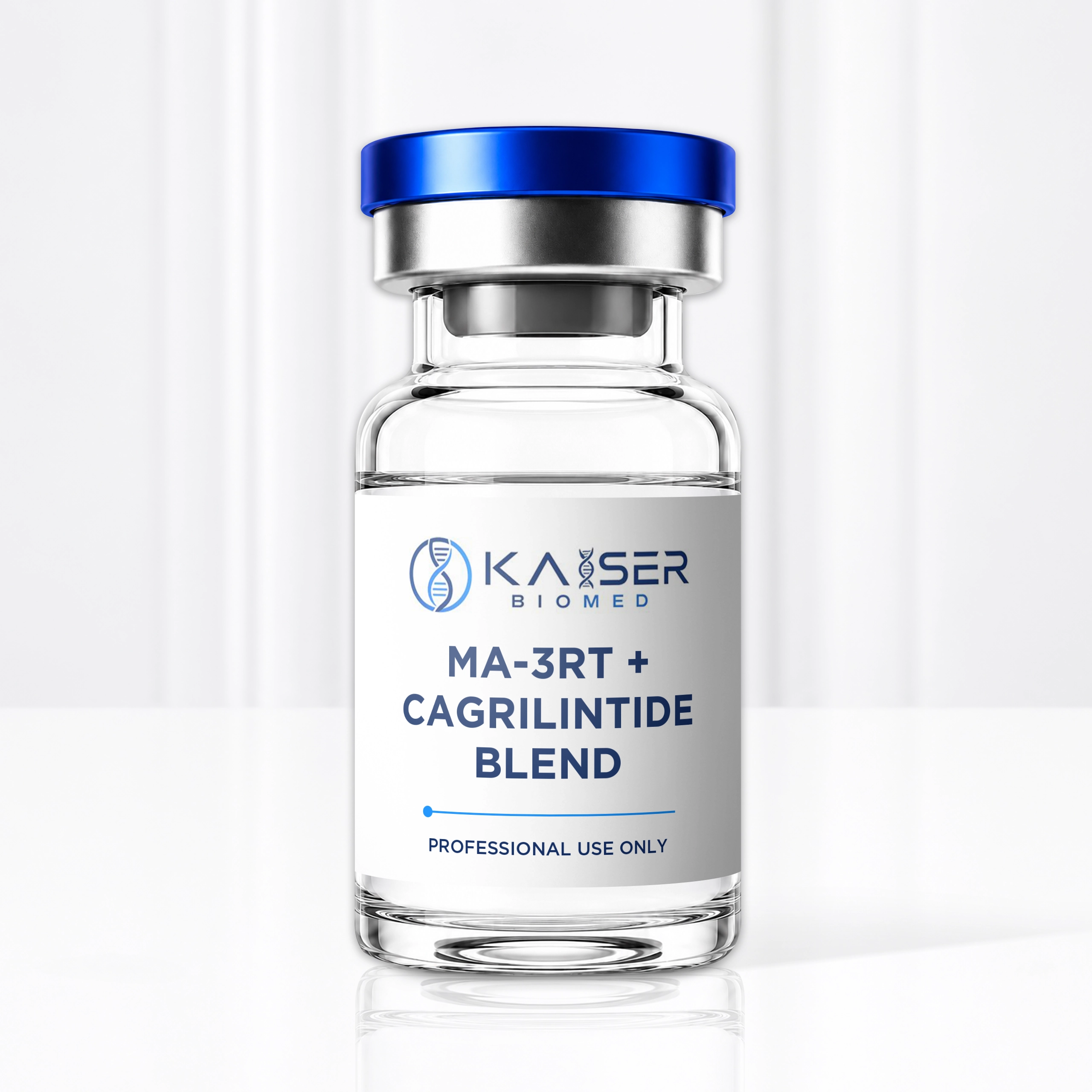
MA-3RT + Cagrilintide Blend (P-065; 8 MG MA-3RT + 2 MG Cagrilintide; 10 MG total lyophilized vial) is a dual-compound formulation pairing a GLP-1/GIP/glucagon triple-receptor agonist (MA-3RT) with a long-acting, lipidated amylin/calcitonin receptor agonist (Cagrilintide), designed to engage five distinct receptor systems involved in energy homeostasis and weight regulation. MA-3RT — a 39-amino acid GIP-backbone peptide with a C20 fatty diacid conjugate — simultaneously activates GLP-1R, GIPR, and glucagon receptor (GCGR) pathways, driving insulin secretion, hepatic fatty acid oxidation, and brown adipose tissue thermogenesis. Cagrilintide (AM833) is a lipidated 37-amino acid amylin analog that functions as a full agonist at AMY1R, AMY2R, AMY3R, and the calcitonin receptor (CTR), targeting hindbrain circuits — including the area postrema and nucleus tractus solitarius — that are distinct from the incretin pathways activated by MA-3RT. Phase 2 clinical programs for each component have documented complementary and additive metabolic effects: the combination strategy targets non-overlapping receptor populations, providing a mechanistic rationale for concurrent administration in the study of complex metabolic regulation. The formulation is supplied as a lyophilized powder requiring reconstitution and is intended for qualified research professionals in endocrinology, metabolic medicine, and obesity pharmacology.
Clinical Research Indications
Each component carries an independent clinical evidence base; together they address convergent and complementary metabolic targets:
- Obesity and Body-Weight Reduction: MA-3RT Phase 2 data demonstrate up to 24.2% mean weight loss at 48 weeks; Cagrilintide Phase 2 monotherapy produced ~10.8% loss at 26 weeks, with additive effect documented when combined with a separate GLP-1 agonist.
- Visceral Adiposity and Hepatic Steatosis: Glucagon receptor agonism by MA-3RT drives hepatic fatty acid beta-oxidation and FGF21 induction; Cagrilintide’s amylinergic mechanism suppresses postprandial glucagon secretion and delays gastric emptying, modulating ectopic lipid accumulation through an independent pathway.
- Type 2 Diabetes Glycemic Control: MA-3RT Phase 2 T2D data show ~2.02 percentage-point HbA1c reduction at 36 weeks; Cagrilintide restores amylin-co-secretion signaling that is lost as beta-cell function declines, addressing a regulatory gap not covered by incretin agonism alone.
- Neurohormonal Satiety Regulation: The blend engages both GLP-1 receptor-expressing forebrain neurons (hypothalamic arcuate nucleus, PVN) and amylin/calcitonin receptor-expressing hindbrain neurons (area postrema, NTS, lateral parabrachial nucleus), activating complementary satiety circuits simultaneously.
Contraindications
- Personal or Family History of Medullary Thyroid Carcinoma / MEN2: Long-acting GLP-1 receptor agonists cause dose-dependent C-cell hyperplasia in rodent models; use is contraindicated in individuals with a history of MTC or Multiple Endocrine Neoplasia type 2 (MEN2).
- Severe Gastroparesis: Both components independently delay gastric emptying — MA-3RT via GLP-1R agonism and Cagrilintide via amylinergic slowing — creating additive risk of markedly worsening pre-existing gastric dysmotility.
- Pregnancy: The impact of rapid weight reduction and dual endocrine agonism on fetal development is unknown; both compounds should be discontinued well in advance of planned conception.
- Hypercalcemia / Calcitonin-Sensitive Conditions: Cagrilintide’s calcitonin receptor (CTR) agonism may interact with calcium homeostasis pathways; relevant history warrants additional monitoring consideration.
Mechanism of Action (MOA)
The blend activates five receptor classes across incretin, glucagonergic, and amylinergic systems, each contributing a mechanistically distinct layer of metabolic regulation:
MA-3RT — GLP-1 Receptor Agonism: Satiety and Insulin Secretion
MA-3RT activates GLP-1 receptors (GLP-1R) in the arcuate nucleus and PVN, stimulating Pro-opiomelanocortin (POMC) neurons to suppress appetite via MC4R. Glucose-dependent insulinotropism in pancreatic beta-cells restores biphasic insulin response; slowed gastric emptying prolongs postprandial satiation. GIP receptor hyper-agonism (~8.9×) simultaneously attenuates GI tolerability issues that can limit dose escalation.
MA-3RT — Glucagon Receptor Agonism: Hepatic Lipolysis and Thermogenesis
Sub-potent (~0.3×) but metabolically meaningful activation of hepatic glucagon receptors (GCGRs) drives the cAMP-PKA pathway, upregulating CPT1A and PPARα to increase mitochondrial fatty acid beta-oxidation. FGF21 induction and brown adipose tissue (BAT) UCP-1 uncoupling elevate resting energy expenditure — a thermogenic effect not replicated by GLP-1 mono-agonism.
Cagrilintide — AMY1R/AMY3R Agonism: Hindbrain Satiety Signaling
Cagrilintide acts as a full agonist at all three amylin receptor subtypes — AMY1R (CTR + RAMP1), AMY2R (CTR + RAMP2), and AMY3R (CTR + RAMP3) — as well as at the calcitonin receptor directly. Neuronal activation in the area postrema and nucleus tractus solitarius (NTS) suppresses food intake through hindbrain satiety circuits entirely distinct from GLP-1R forebrain pathways. Preclinical AMY1R/AMY3R knockout studies confirm both receptor subtypes are required for full weight-reducing efficacy.
Synergistic Combination: Complementary Receptor Populations
Because MA-3RT’s incretin pathways (GLP-1R, GIPR, GCGR) and Cagrilintide’s amylinergic pathways (AMY1R, AMY2R, AMY3R, CTR) operate through distinct receptor populations in separate brain regions, their combination engages non-overlapping satiety circuits simultaneously. Cagrilintide’s postprandial glucagon suppression complements MA-3RT’s glucagon receptor agonism, and its independent amylinergic regulation of meal-termination signals reinforces the central appetite suppression from GLP-1/GIP agonism.
Key Features & Specifications
Defining pharmacological and structural attributes of this dual-class metabolic blend:
Chemical Analysis
| Property | Specification Reference Data |
|---|---|
| Component 1 — MA-3RT | GLP-1/GIP/glucagon triple-receptor agonist; 39 AA; GIP-backbone with Aib at position 2 (DPP-4 resistance); C20 fatty diacid on Lys-20 via hydrophilic linker |
| MA-3RT CAS | 2381868-24-0 |
| MA-3RT Molecular Weight | ~4,760 g/mol (intact lipopeptide conjugate) |
| MA-3RT Half-Life | ~6 days (albumin binding via C20 fatty diacid) |
| Component 2 — Cagrilintide | Long-acting amylin analog; 37 AA; h-amylin backbone; N-terminal acylation via eicosanedioic-acid–γ-Glu–Lys linker; non-selective AMY1R/AMY2R/AMY3R/CTR agonist (EC₅₀ 49–79 nM range) |
| Cagrilintide CAS | 1415456-99-3 |
| Cagrilintide Molecular Formula | C194H312N54O59S2 (peptide core) |
| Cagrilintide Molecular Weight | ~4,200 g/mol (lipidated analog; core peptide + acyl chain) |
| Cagrilintide Half-Life | ~159–195 hours (7–8 days; albumin binding) |
| Synonyms (Cagrilintide) | AM833; compound 23; INN cagrilintide |
| Form / Variation | 10 MG Lyophilized Blend Vial (P-065) — 8 MG MA-3RT + 2 MG Cagrilintide |
Storage, Safety, and Handling
Storage Protocol
Store the lyophilized blend vial at −20 °C, protected from light and moisture; do not expose to repeated temperature fluctuations prior to reconstitution. Both components are lipidated peptides with C20 fatty diacid albumin-binding moieties that increase propensity for aggregation on standard plastic surfaces; use low-binding polypropylene labware throughout reconstitution. Once reconstituted with bacteriostatic water for injection, store the solution at 2–8 °C and use within 28 days; avoid freeze-thaw cycling of the reconstituted solution.
Handling & Compliance
Handle with standard laboratory PPE (nitrile gloves, safety glasses) and employ aseptic technique throughout reconstitution and transfer. Both components are potent endocrine agonists with dose-dependent cardiovascular and gastrointestinal activity; dose escalation protocols from clinical pharmacology literature should be observed. Both MA-3RT and Cagrilintide are classified as prohibited substances under the World Anti-Doping Agency (WADA) S4 Hormone and Metabolic Modulators category.