
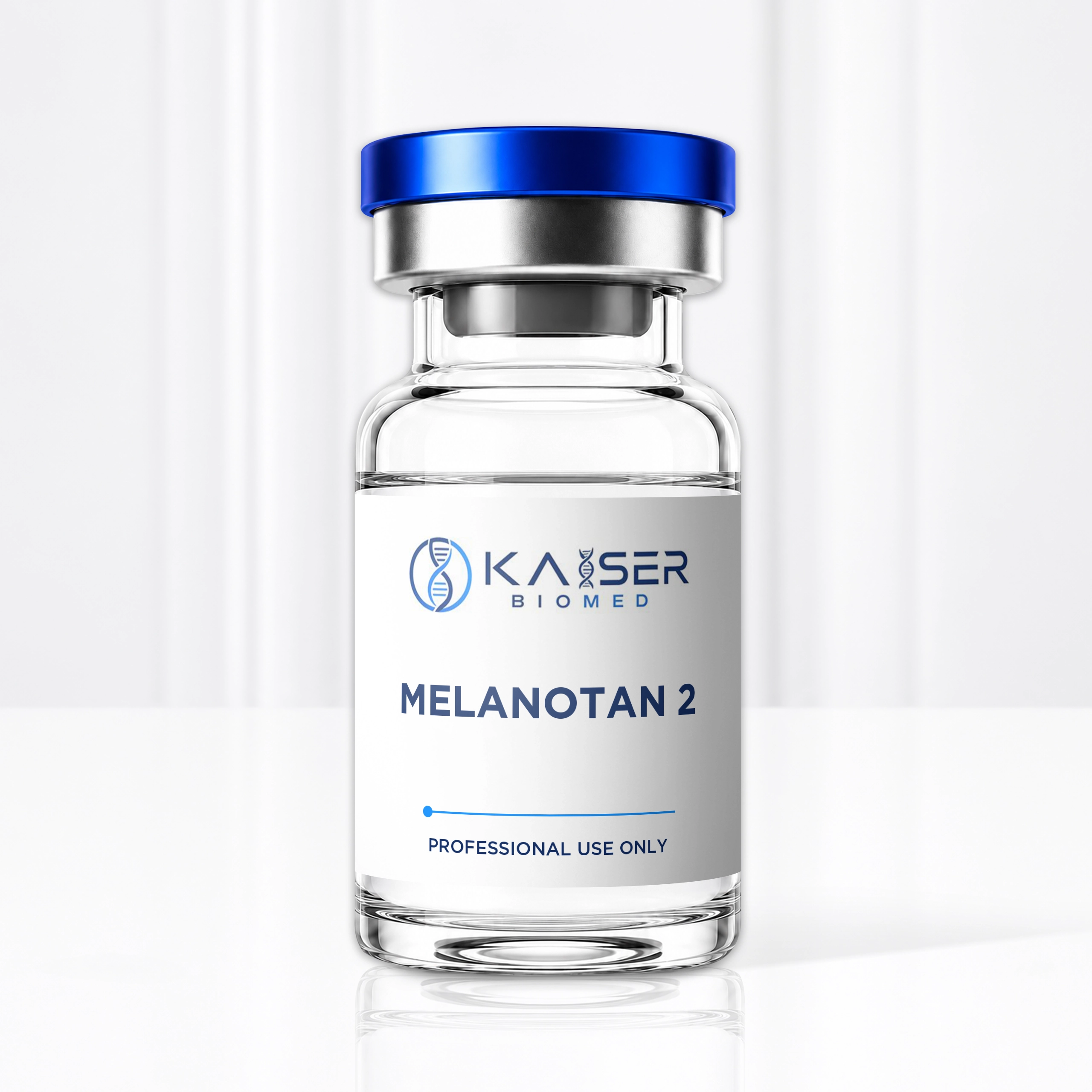
Description
Summary Abstract
Melanotan 2 (MT-II; Ac-Nle-cyclo[Asp-His-D-Phe-Arg-Trp-Lys]-NH2; CAS 121062-08-6) is a synthetic, conformationally constrained cyclic heptapeptide analog of alpha-melanocyte stimulating hormone (α-MSH), originally developed at the University of Arizona through systematic structure-activity relationship studies. The compound is a non-selective agonist at melanocortin receptors MC1R, MC3R, MC4R, and MC5R, achieving nanomolar binding affinities across all four subtypes through a lactam bridge between Asp and Lys residues that pre-organizes the pharmacophore in a receptor-active conformation. Its receptor profile drives a range of research-relevant effects: melanogenesis via MC1R, energy partitioning via MC3R, central appetite and autonomic modulation via MC4R, and exocrine function via MC5R. The incorporation of norleucine, D-phenylalanine, and terminal capping extends plasma half-life substantially beyond linear α-MSH analogs.
Clinical Indications
MT-II’s multi-receptor pharmacology supports investigation across several research domains:
- Melanogenesis and Photoprotection: MC1R agonism on epidermal melanocytes activates the cAMP/PKA/CREB/MITF/tyrosinase cascade, stimulating eumelanin synthesis independent of UV radiation — making MT-II a standard tool for pigmentation pathway research.
- Energy Homeostasis and Obesity: Central MC4R and MC3R activation suppresses food intake and modulates energy partitioning; DIO rodent models show 30–50% food intake reduction and 15–25% body weight decrease with chronic MT-II administration.
- Erectile and Sexual Function Research: MC4R activation triggers neuronal nitric oxide (NO) release in penile corpora cavernosa via a central mechanism, positioning MT-II as a validated pharmacological tool in studies of melanocortin-mediated autonomic and reproductive physiology.
Contraindications
- Pre-existing Melanocytic Lesions: Sustained MC1R activation drives eumelanin synthesis in melanocytes; clinical advisory bodies including the TGA have associated illicit cosmetic MT-II use with development of atypical naevi and melanoma risk, warranting caution in any model with baseline melanocytic pathology.
- Cardiovascular Autonomic Monitoring: MC4R engagement in hypothalamic and brainstem nuclei modulates sympathetic outflow; studies in subjects or models with autonomic instability should include cardiovascular monitoring.
- Nausea-Sensitive Models: MT-II produces dose-dependent nausea and facial flushing via central MC4R/MC3R pathways, which limits effective dose ranges in protocols requiring sustained dosing.
Mechanism of Action (MOA)
MT-II exerts its effects through non-selective agonism at four melanocortin receptor subtypes, each driving distinct downstream cascades:
MC1R — Melanogenesis
MT-II binding to MC1R on epidermal melanocytes activates Gαs, raising intracellular cAMP and activating PKA. PKA phosphorylates CREB, which transactivates the MITF gene (microphthalmia-associated transcription factor), the master regulator of the melanocyte lineage, leading to tyrosinase upregulation and eumelanin production.
MC4R — Appetite and Autonomic Regulation
Dense hypothalamic MC4R expression in the paraventricular nucleus mediates MT-II’s anorectic effects through suppression of orexigenic signaling and elevation of sympathetic tone. Central MC4R activation also engages neuronal NO synthesis in the pudendal nerve pathway, providing the mechanistic basis for cavernosal pressure increases observed in erectile physiology studies.
MC3R — Energy Partitioning
MC3R activation by MT-II modulates how ingested calories distribute between lean and adipose compartments, distinct from the appetite-suppressive MC4R pathway. This receptor subtype is implicated in the metabolic — rather than behavioral — component of MT-II’s anti-obesity profile in preclinical models.
Key Features & Specifications
MT-II is defined by its conformationally constrained scaffold and broad melanocortin receptor activity profile:
Chemical Analysis
| Property | Specification Reference Data |
|---|---|
| Sequence | Ac-Nle-cyclo[Asp-His-D-Phe-Arg-Trp-Lys]-NH2 |
| CAS Number | 121062-08-6 |
| Molecular Formula | C50H69N15O9 |
| Molecular Weight | 1024.2 g/mol |
| PubChem CID | 92432 |
| Synonyms | MT-II, Melanotan-II, MTII |
| Form / Variation | 10 MG Lyophilized (SKU P-026) |
Storage, Safety, and Handling
Storage Protocol
Store lyophilized MT-II at −20 °C in a sealed, desiccated vial protected from light. Reconstitute with sterile bacteriostatic water; reconstituted peptide should be stored at 4 °C and used within 28 days. Avoid freeze-thaw cycles post-reconstitution, as cyclic peptides can degrade at the lactam bridge under repeated thermal stress.
Handling & Compliance
Handle with gloves and standard laboratory PPE. MT-II is classified as a Schedule 4 prescription-only substance by the TGA (Australia) and is unapproved for cosmetic or therapeutic use across major regulatory jurisdictions. It is listed on the WADA prohibited list within the category of peptide hormones and related substances. Investigators should ensure institutional regulatory compliance before initiating any protocols involving this peptide.