
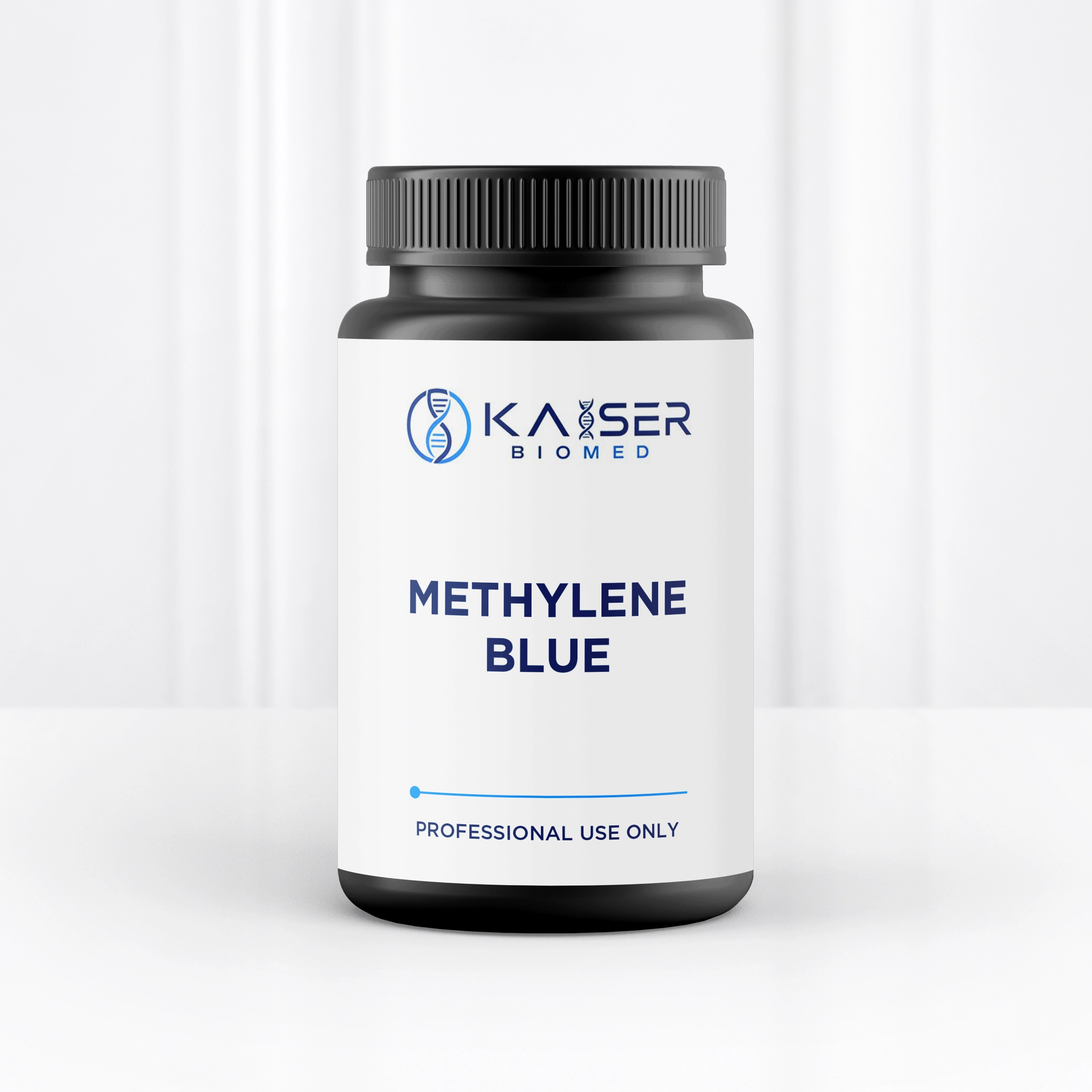
Description
Summary Abstract
Methylene Blue (methylthioninium chloride; CAS 61-73-4; C16H18ClN3S; MW 319.85 g/mol; PubChem CID 6099) is a phenothiazine derivative first synthesized in 1876 by Heinrich Caro and the first synthetic drug used clinically, initially as an antimalarial (Ehrlich and Guttmann, 1891). Its defining pharmacological attribute is its reversible redox oscillation between the oxidized (methylene blue, deep blue) and reduced (leucomethylene blue, colorless) states. This low-molecular-weight, amphiphilic molecule crosses the blood-brain barrier and accumulates preferentially in neuronal and cardiac mitochondria. At low nanomolar-to-micromolar concentrations it functions as an exogenous electron cycler, shuttling electrons from NADH at Complex I to cytochrome c (Complex IV) and bypassing Complexes I and III blockages to sustain ATP synthesis and mitochondrial membrane potential. At higher doses it inhibits inducible nitric-oxide synthase (iNOS) and soluble guanylate cyclase (sGC), restoring vascular smooth-muscle tone in vasoplegic and septic shock — a use supported by multiple prospective RCTs demonstrating accelerated vasopressor discontinuation and shorter ICU stays. Its reduced form HMTM (hydromethylthionine mesylate) demonstrated sustained cognitive preservation and significant biomarker improvements (p-Tau217, NfL, brain atrophy) in the LUCIDITY Phase 3 AD trial. Methylene blue also exhibits potent, G6PD-safe gametocytocidal activity in Plasmodium falciparum malaria.
Clinical Indications
Methylene blue’s multi-target redox-cycling profile supports investigation across several critical clinical domains:
- Methemoglobinemia (FDA-Approved Indication): The NADPH-dependent reduction of methylene blue to leucomethylene blue in erythrocytes non-enzymatically reduces ferric methemoglobin Fe³⁺ to functional ferrous hemoglobin Fe²⁺, restoring oxygen-carrying capacity within minutes; clinically ineffective and pro-hemolytic in G6PD-deficient patients.
- Vasoplegic / Septic Shock: Dual iNOS inhibition and sGC competitive binding interrupt the NO → cGMP → vasodilation cascade; RCT-level evidence for accelerated vasopressor discontinuation (−1 median day) and reduced ICU length of stay.
- Alzheimer’s Disease / Mild Cognitive Impairment: HMTM (the stable oral reduced form) inhibits tau aggregation and upregulates Complex IV; LUCIDITY Phase 3 data demonstrated sustained cognitive preservation over 78 weeks, reduced brain atrophy, and significant reduction in p-Tau217 and NfL progression.
- Malaria Transmission Blockade: Potent gametocytocidal activity in Phase 2 RCTs; complete transmission blockade to Anopheles vectors within 48 hours when combined with dihydroartemisinin-piperaquine; G6PD-safe at antimalarial doses unlike primaquine.
- Antiviral Mechanisms: Viral RNA–protein cross-linking via positive-charge electrostatic interactions; zinc ionophore action inhibiting viral RNA-dependent RNA polymerase; iNOS inhibition addressing cytokine-storm mitochondrial blockade.
Contraindications
- G6PD Deficiency (Methemoglobinemia Treatment): Insufficient NADPH prevents reduction of MB to leucoMB; accumulated oxidized MB exacerbates hemolytic anemia rather than correcting methemoglobinemia.
- NADPH Methemoglobin Reductase Deficiency: Same mechanistic failure; methylene blue is clinically ineffective.
- Serotonergic Agents (5-HT Syndrome Risk): Methylene blue inhibits MAO-A; concurrent use with SSRIs, SNRIs, or other serotonergic drugs at higher IV doses poses a risk of serotonin syndrome.
- Renal or Hepatic Impairment: Elimination half-life (~5.25 h normal) is significantly prolonged; dose adjustment required to prevent systemic accumulation and pro-oxidant high-dose effects.
Mechanism of Action (MOA)
Methylene blue functions as a dynamic redox network modulator rather than a conventional single-target ligand, engaging multiple physiological systems via thermodynamic electron-cycling chemistry:
Mitochondrial Electron Shuttle (Bypass)
Oxidized methylene blue accepts electrons from NADH or enzymatic donors at Complex I, reducing to leucomethylene blue. The highly diffusible leucoMB bypasses Complexes I and III and donates electrons directly to cytochrome c (Complex IV). Re-oxidation restarts the catalytic cycle. This bypass sustains proton pumping, preserves mitochondrial membrane potential, and maintains ATP synthesis even when upstream ETC components are blocked by rotenone, ROS damage, or excess nitric oxide — the characteristic condition in neurodegeneration, ischemia, and septic organ failure.
iNOS / sGC Cascade Interruption
In vasoplegic and septic states, cytokine-driven iNOS overproduction floods the circulation with nitric oxide (NO), which activates sGC → cGMP → PKG, sequestering intracellular Ca²⁺, dephosphorylating myosin, and opening K⁺ channels to produce refractory vasodilation. Methylene blue directly inhibits iNOS and competitively binds the iron-heme moiety of sGC, preventing NO-induced activation, while also scavenging circulating NO, rapidly restoring mean arterial pressure and vascular smooth-muscle contractility.
Tau Aggregation Inhibition and NRF1/Complex IV Induction
The methylthioninium core directly inhibits tau protein aggregation into neurofibrillary tangles — the primary mechanism of HMTM (hydromethylthionine mesylate) in Alzheimer’s disease. Concurrently, a modest ROS signal generated by Complex I substrates activates the NRF1 transcriptional cascade, upregulating Complex IV subunit expression, promoting mitochondrial biogenesis, and stimulating mitophagy of damaged organelles. This combined tau-targeted and bioenergetic mechanism differentiates methylene blue from purely amyloid-targeting approaches.
Gametocytocidal / Antimalarial Mechanism
Methylene blue sterilizes Plasmodium falciparum gametocytes before reducing their physical density, preferentially clearing male gametocytes and altering viable sex ratios. It blocks parasite zygote-to-ookinete transformation and prevents sporozoite invasion of hepatocytes. Because its activity depends on fundamental redox chemistry rather than a mutable enzymatic target, resistance emergence is highly improbable — a critical advantage over current single-target artemisinin combinations facing partial resistance.
Key Features & Specifications
Methylene blue spans approved and investigational clinical applications across a uniquely broad therapeutic scope:
Chemical Analysis
| Property | Specification Reference Data |
|---|---|
| IUPAC Name | [7-(Dimethylamino)phenothiazin-3-ylidene]-dimethylazanium chloride |
| CAS Number | 61-73-4 |
| Molecular Formula | C16H18ClN3S |
| Molecular Weight | 319.85 g/mol |
| PubChem CID | 6099 |
| Synonyms | Methylthioninium chloride, Basic Blue 9, Swiss Blue, Urolene Blue, Provayblue, MB, MTB |
| Form / Variation | 5 MG Capsules (SKU C-023) / 10 MG Capsules (SKU C10-022) / Liquid 10 MG/mL 30 mL (SKU L-017) |
Storage, Safety, and Handling
Storage Protocol
Store capsules and liquid formulations at room temperature (15–25 °C), protected from direct light; methylene blue photodegrades upon prolonged UV exposure. Liquid formulations should be stored in amber glass or opaque containers. Capsules maintain stability in sealed, moisture-proof packaging. Elimination half-life of ~5.25 hours is prolonged in renal or hepatic impairment; protein binding ~94% at therapeutic concentrations.
Handling & Compliance
Methylene blue exhibits a critical biphasic dose-response: low nanomolar-to-micromolar concentrations are cytoprotective while high concentrations (overdose) are pro-oxidant and can induce methemoglobinemia, hemolysis, and serotonin syndrome when combined with serotonergic drugs. IV preparations require strict dose control; oral formulations at supplemental doses (5–10 mg) fall within the cytoprotective hormetic window. Methylene blue stains skin, mucous membranes, and urine blue-green — inform patients accordingly. Serotonin syndrome risk with concurrent serotonergic agents is a black-box concern at IV doses ≥1 mg/kg.