
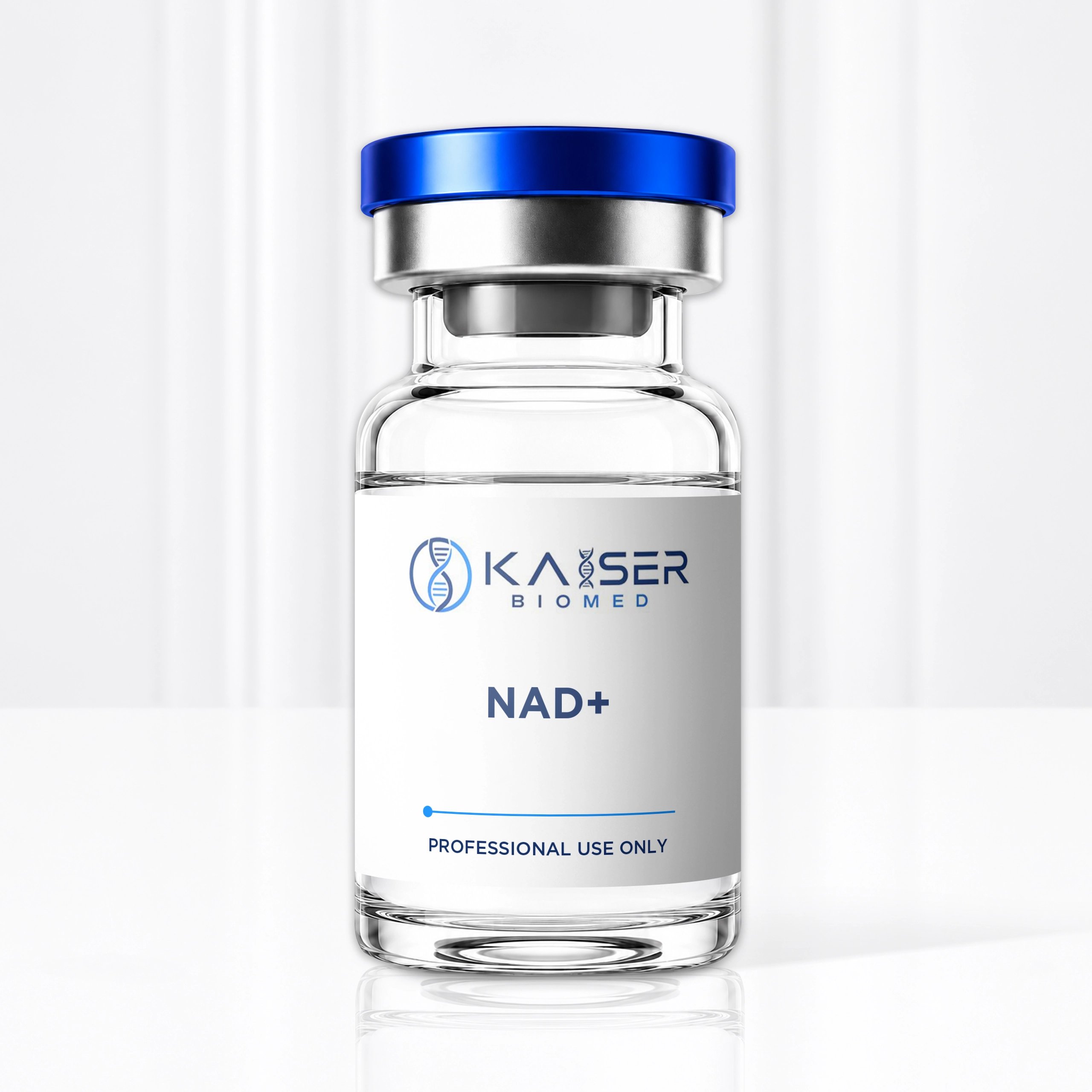
Description
Summary Abstract
NAD+ (Nicotinamide Adenine Dinucleotide; Coenzyme I; β-NAD; DPN) is a dinucleotide coenzyme present in all living cells, serving mechanistically distinct dual roles as the primary hydride-transfer cofactor for cellular oxidation-reduction reactions and as an obligate substrate consumed by sirtuins (SIRT1–7), poly(ADP-ribose) polymerases (PARPs), and the cyclic ADP-ribose hydrolase CD38. Intracellular NAD+ concentrations decline progressively with age, driven by chronic PARP activation from accumulating DNA damage and age-associated upregulation of the ectoenzyme CD38 during chronic low-grade inflammation (“inflammaging”). This decline impairs sirtuin-dependent regulation of mitochondrial biogenesis, DNA damage response, and circadian alignment. NAD+ repletion has emerged as a major axis of translational metabolism and longevity research, with clinical trial evidence from NMN and NR precursor programs and direct parenteral NAD+ administration providing complementary approaches to systemic repletion.
Clinical Indications
NAD+ pathway modulation has been investigated across metabolic, cardiovascular, neurological, and oncological domains:
- Insulin Resistance & Metabolic Disease: NMN (250 mg/day, 10 weeks) improved skeletal muscle insulin sensitivity and insulin signaling in prediabetic women (Yoshino et al., 2021, Science); NAD+ pathway modulation is under study in NAFLD, NASH, and type 2 diabetes.
- Cardiovascular / Peripheral Artery Disease: NR (1000 mg/day, 12 weeks) improved 6-minute walk distance in a Phase II peripheral artery disease trial, attributed to mitochondrial function restoration in skeletal muscle.
- Neurodegeneration & Axonal Biology: NAD+ depletion is implicated in axonal degeneration (SARM1 pathway) and mitochondrial dysfunction in Alzheimer’s, Parkinson’s, and ALS models; SIRT1 and SIRT3 activation via NAD+ repletion is neuroprotective in rodent studies.
- DNA Damage Response: PARP-dependent DNA repair relies on sustained NAD+ supply; NAD+ repletion may support genome stability under elevated oxidative or genotoxic stress conditions.
- Aging Biology & Longevity: NAD+ decline is a conserved hallmark of aging from yeast to primates; precursor supplementation extends healthspan in multiple mouse models.
Contraindications
- Active Malignancy (High-Dose NR/NMN): Preclinical data in murine breast cancer models raised signals that high-dose nicotinamide riboside supplementation may accelerate metastasis; researchers should exercise caution and review current literature before use in oncology models.
- Concurrent PARP Inhibitor Chemotherapy: NAD+ supplementation may theoretically counteract the mechanism of PARP-inhibitor oncology agents; concurrent use in active cancer treatment protocols warrants pharmacological review.
- Rapid IV Infusion: High-rate intravenous NAD+ infusion is associated with chest tightness, palpitations, and injection site discomfort; slow titrated infusion is required when the parenteral route is used in clinical or research settings.
Mechanism of Action (MOA)
NAD+ functions through two separable biochemical modes — as an electron carrier in oxidative metabolism and as a consumed substrate for regulatory enzyme families:
Redox Metabolism (Electron Transfer)
NAD+ accepts a hydride ion (H−) from metabolic substrates via glycolysis, the TCA cycle, and fatty acid β-oxidation, becoming NADH. NADH donates electrons to Complex I of the mitochondrial electron transport chain, driving ATP synthesis. The cytosolic NAD+/NADH ratio (~700:1 normally) governs glycolytic flux; the mitochondrial ratio (~7–8:1) reflects ongoing oxidative phosphorylation — imbalance signals metabolic stress.
Sirtuin Substrate (SIRT1–7)
Sirtuins are NAD+-dependent deacylases consuming one NAD+ molecule per catalytic cycle. SIRT1 deacetylates PGC-1α to drive mitochondrial biogenesis; SIRT3 activates SOD2 antioxidant defense; SIRT6 maintains telomere integrity and suppresses NF-κB. Declining NAD+ impairs the entire sirtuin regulatory network, linking energy sensing, epigenetics, and the aging phenotype.
PARP & CD38 Consumption
PARP1 detects DNA strand breaks and catalyzes poly-ADP-ribosylation of repair proteins using NAD+ as substrate — PARP1 alone can consume >90% of cellular NAD+ during severe genotoxic stress. CD38, upregulated with age and inflammation, generates cyclic ADP-ribose for calcium signaling while consuming NAD+. CD38 knockout mice show markedly preserved NAD+ levels and improved mitochondrial function with age.
Key Features & Specifications
NAD+ is available at Kaiser BioMed in multiple delivery formats optimized for parenteral and direct research applications:
Chemical Analysis
| Property | Specification Reference Data |
|---|---|
| IUPAC Name | [(2R,3S,4R,5R)-5-(3-carbamoylpyridin-1-ium-1-yl)-3,4-dihydroxyoxolan-2-yl]methyl [[(2R,3S,4R,5R)-5-(6-aminopurin-9-yl)-3,4-dihydroxyoxolan-2-yl]methoxy-oxidophosphoryl] hydrogen phosphate |
| CAS Number | 53-84-9 |
| Molecular Formula | C21H27N7O14P2 |
| Molecular Weight | 663.43 g/mol |
| PubChem CID | 5892 |
| Synonyms | Nicotinamide Adenine Dinucleotide; NAD; Coenzyme I; β-NAD; DPN (Diphosphopyridine Nucleotide) |
| Form / Variation | 500 MG Lyophilized (P-063) / 200 MG/mL × 20 mL Reconstituted (A-012-F) |
Storage, Safety, and Handling
Storage Protocol
Lyophilized NAD+ (P-063) must be stored at −20°C, protected from light and moisture; the material is hygroscopic — minimize time-to-reseal after each use, and prefer nitrogen-purged or vacuum-sealed vials for long-term storage. Reconstituted injectable (A-012-F) should be refrigerated at 2–8°C and used within 28 days; do not freeze the reconstituted solution and protect from light at all times. Discard any preparation showing yellow-orange discoloration, which indicates oxidation to GSSG-analogous species.
Handling & Compliance
Prepare reconstituted solutions under sterile technique using gloves and appropriate PPE; use amber or foil-protected containers to minimize photo-oxidative degradation during handling. IV administration requires slow titrated infusion; rapid IV delivery has been associated with transient palpitations and chest discomfort in clinical reports. NAD+ (CAS 53-84-9) as a direct preparation is not subject to the FDA’s 2023 NMN dietary supplement ruling; it is available as a pharmaceutical-grade compounded injectable for licensed practitioners.