
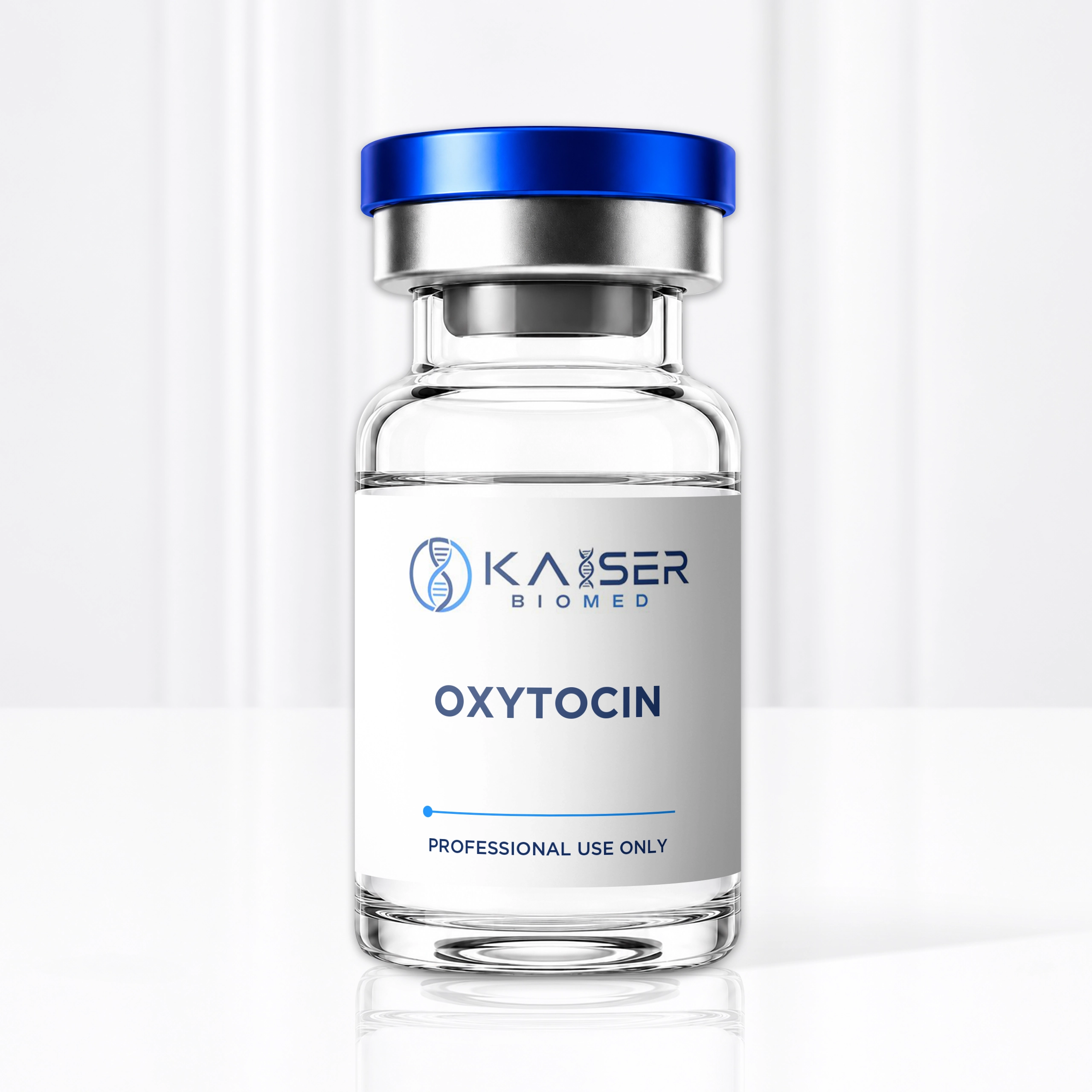
Description
Summary Abstract
Oxytocin (OT; Cys-Tyr-Ile-Gln-Asn-Cys-Pro-Leu-Gly-NH₂; disulfide-bridged cyclic nonapeptide; C43H66N12O12S2; MW 1,007.19 g/mol; CAS 50-56-6; PubChem CID 439302) is a hypothalamic nonapeptide synthesized primarily in the magnocellular and parvocellular neurons of the Paraventricular Nucleus (PVN) and Supraoptic Nucleus (SON). Originally classified as a uterotonic obstetric hormone, decades of neurobiological research have expanded its conceptualization to that of a pleiotropic neuromodulator governing the central nervous system’s “social brain” network — encompassing social cognition, fear regulation, pair bonding, empathy, analgesia, and metabolic energy balance. Its primary receptor, the Oxytocin Receptor (OTR), is a G-protein-coupled receptor coupling primarily to Gq/11 to mobilize calcium and activate PKC, MAPK, and CREB pathways; it also functions as a Positive Allosteric Modulator (PAM) of µ- and κ-opioid receptors to produce synergistic analgesia. FDA-approved indications include induction of labor and management of postpartum hemorrhage (PPH). Investigational clinical evidence supports applications in autism spectrum disorder (ASD), schizophrenia (negative symptoms), obesity, PTSD, and chronic pain. Intranasal administration, hypothesized to utilize olfactory and trigeminal nose-to-brain pathways, has been the standard research delivery route for neuropsychiatric applications; however, the relative contributions of direct CNS access versus peripheral vagal afferent activation remain mechanistically debated.
Clinical Indications
Oxytocin spans approved obstetric applications and a rapidly expanding investigational neuropsychiatric and metabolic portfolio:
- Labor Induction and Augmentation (FDA Approved): Standard of care for cervical ripening and labor augmentation via continuous IV infusion, titrated against uterine contraction frequency in appropriate obstetric candidates.
- Postpartum Hemorrhage (PPH) Prevention and Management (FDA Approved): Immediate IM or IV administration post-placental delivery induces uterine contraction to mechanically occlude spiral arteries; first-line pharmacological intervention for uterine atony.
- Autism Spectrum Disorder (ASD) — Investigational: Single-dose studies consistently demonstrate improved social cognition (eye-region gaze, theory-of-mind) in ASD; randomized trials in children aged 3–5 show improvements in social responsiveness; efficacy is more limited in adults and for repetitive behaviors.
- Schizophrenia (Negative Symptoms) — Investigational: Meta-analyses support dose-dependent reduction of negative symptoms (flat affect, social withdrawal) at 40–80 IU/day intranasal; may restore amygdala-prefrontal connectivity impaired in schizophrenia.
- Metabolic and Obesity Research: Pilot RCTs (24 IU intranasal q.i.d.) demonstrate reduced snack intake and improved insulin sensitivity; BAT thermogenesis activation and direct lipolytic effects on white adipocytes provide mechanistic basis for body composition applications.
Contraindications
- Hyponatremia Risk / Severe Renal Impairment: High-dose or prolonged IV oxytocin activates V2 receptors in the renal collecting duct (Aquaporin-2 insertion), causing antidiuresis and dilutional hyponatremia; progression to cerebral edema and seizures is life-threatening; strict fluid management and sodium monitoring required.
- Obstetric Contraindications: Absolute contraindication when vaginal delivery is not advisable: cephalopelvic disproportion, placenta previa, fetal malpresentation, prior classical uterine incision, or active genital herpes with intact membranes.
- Long QT Syndrome / Antipsychotic or SSRI Co-medication: OT prolongs the QTc interval; potentially dangerous additive QTc prolongation with antipsychotics (typical and atypical) and SSRIs; ECG monitoring is recommended.
- MDMA Co-administration: MDMA independently releases ADH and promotes water retention; combined with oxytocin’s V2 agonism, the risk of life-threatening hyponatremia is substantially increased.
Mechanism of Action (MOA)
Oxytocin engages a multi-receptor pharmacology driving diverse physiological responses across organ systems:
Canonical OTR / Gq/11 — Calcium Mobilization and Smooth Muscle Contraction
Oxytocin binding to the OTR activates Gαq/11, which stimulates phospholipase C-β to hydrolyze PIP₂ into IP₃ and DAG. IP₃ triggers intracellular Ca²⁺ release from the endoplasmic reticulum; in the uterine myometrium, Ca²⁺-calmodulin activates Myosin Light Chain Kinase (MLCK) to drive smooth muscle contraction. Downstream MAPK activation via PKC drives long-term behavioral and gene expression changes underlying pair bonding and maternal memory.
Central “Social Brain” Network — Amygdala, NAc, VTA
OTR-dense regions of the social brain include the basolateral amygdala (fear attenuation), Nucleus Accumbens (NAc; reward reinforcement), and Ventral Tegmental Area (VTA; dopamine modulation). In the NAc, concurrent OTR and dopamine D2 receptor activation during rewarding social interaction “imprints” social partners as rewarding stimuli, forming the neurobiological basis of pair bonding. Amygdala OTR activation reduces the autonomic fear response to social cues, producing anxiolytic effects relevant to ASD and PTSD.
Opioid Receptor Positive Allosteric Modulation — Synergistic Analgesia
OT functions as a Positive Allosteric Modulator (PAM) of µ- and κ-opioid receptors without binding the orthosteric site, enhancing endogenous opioid signaling and G-protein coupling without recruiting β-arrestin (which causes receptor desensitization). Spinal OT release from PVN parvocellular projections activates inhibitory GABAergic interneurons in the dorsal horn, blocking nociceptive A-delta and C-fiber transmission. This pathway is partially reversed by naloxone, confirming endogenous opioid system co-recruitment.
Metabolic Axis — BAT Thermogenesis, Lipolysis, and Bone Protection
OT increases sympathetic outflow to Brown Adipose Tissue (BAT), upregulating UCP-1 to drive thermogenesis. It acts directly on white adipocytes to promote lipolysis and suppress adipose tissue inflammation. Notably, OT stimulates osteoblast differentiation and upregulates osteoprotegerin, protecting bone density — a clinically relevant benefit distinguishing OT-based metabolic intervention from strategies that compromise skeletal integrity during weight loss.
Key Features & Specifications
Key structural and pharmacological attributes of oxytocin:
Chemical Analysis
| Property | Specification Reference Data |
|---|---|
| Sequence | Cys-Tyr-Ile-Gln-Asn-Cys-Pro-Leu-Gly-NH₂ (disulfide bridge: Cys1–Cys6; cyclic nonapeptide; C-terminal amide) |
| CAS Number | 50-56-6 |
| Molecular Formula | C43H66N12O12S2 |
| Molecular Weight | 1,007.19 g/mol |
| PubChem CID | 439302 |
| Synonyms | Pitocin, Syntocinon, OT, Oxt |
| Form / Variation | 5 MG Lyophilized (P-047) |
Storage, Safety, and Handling
Storage Protocol
Store lyophilized oxytocin at 2–8 °C or −20 °C (lyophilized powder is stable at both); protect from light and freeze-thaw cycles of the reconstituted solution. Reconstituted solutions for IV infusion are stable at room temperature for 24 hours; intranasal formulations should be stored per manufacturer specifications (typically 2–8 °C after opening). The disulfide bridge is essential for receptor binding; avoid reducing agents and strongly oxidizing conditions in preparation.
Handling & Compliance
Handle with standard PPE under aseptic conditions. The primary systemic risks are hyponatremia (V2 receptor antidiuresis at high or cumulative doses), QTc prolongation (monitor ECG in at-risk patients), and acute hypotension from rapid IV bolus (vasodilation via NO). Intranasal dosing (typical research range: 24–80 IU) carries lower hyponatremia risk than IV but cumulative effects with polydipsia or MDMA co-administration remain hazardous. Chronic administration may induce OTR downregulation in the NAc; cycling protocols are recommended in neuropsychiatric research applications. Oxytocin is FDA-approved (Pitocin); use outside approved obstetric indications is off-label.