
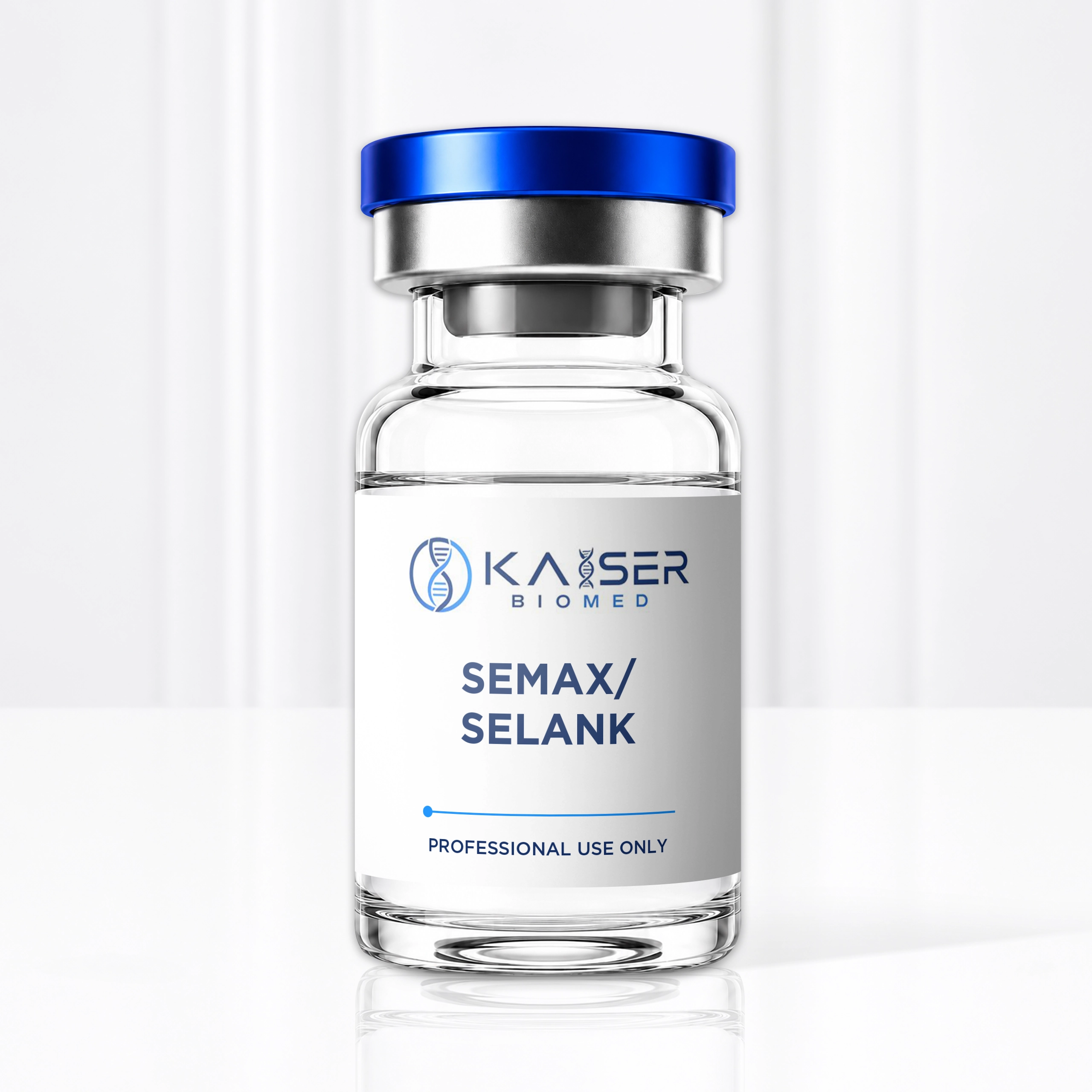
Description
Summary Abstract
Semax / Selank are synthetic heptapeptides developed at the Institute of Molecular Genetics of the Russian Academy of Sciences, each representing a distinct neuropsychopharmacological profile and both registered as pharmaceutical drugs in Russia and Ukraine. Semax (ACTH(4-10)-PGP; Met-Glu-His-Phe-Pro-Gly-Pro) is derived from the ACTH(4-10) neuropeptide fragment responsible for behavioral modulation — not adrenal steroidogenesis — with a C-terminal Pro-Gly-Pro stabilization, and is studied for nootropic enhancement, BDNF/TrkB co-upregulation, neuroprotection, and ischemic stroke recovery. Selank (Tuftsin analog; TKPRPGP; TP-7) is derived from the immunomodulatory tetrapeptide tuftsin with a C-terminal stability extension, and is characterized by GABAergic anxiolysis comparable to low-dose diazepam without sedation, dependence, or cognitive impairment. Both peptides are available individually (P-036, P-033) and as a fixed-dose lyophilized combination (P-055), reflecting their complementary and potentially synergistic neurotrophin and anxiolytic mechanisms. Neither is currently on the WADA Prohibited List.
Clinical Indications
Semax and Selank have been evaluated in controlled clinical settings for neurological, psychiatric, and cognitive endpoints:
- Ischemic Stroke Recovery (Semax): Russian Phase II/III RCT (n=110): intranasal Semax (1.0%) within 6h improved Barthel Index and Scandinavian Stroke Scale at 30 days; plasma BDNF elevation correlated quantitatively with functional recovery.
- Generalized Anxiety Disorder (Selank): Phase II trials (~100 subjects) demonstrated HAM-A improvements comparable to low-dose diazepam at 14–28 days, without sedation or withdrawal — basis for Russian registration for GAD and neurasthenia.
- Cognitive Performance Under Stress: Semax increased default mode network volume in medial prefrontal cortex under acute cognitive load (Lebedeva et al., fMRI); Selank improved cognitive performance and memory consolidation in healthy volunteers under psychogenic stress.
- Neurotrophin Research (BDNF/NGF): Semax simultaneously upregulates BDNF and TrkB, making it a pharmacological probe for BDNF-TrkB co-regulation studies; NGF induction occurs with ~8-hour delay suggesting indirect transcription-dependent pathway.
Contraindications
- Pregnancy & Lactation (Semax): Listed contraindication in Russian prescribing information; the neurotrophin-stimulating activity of Semax during fetal development is not characterized.
- Convulsive Disorder History (Semax): Semax is contraindicated in patients with history of convulsive disorders per Russian clinical protocol; the pro-dopaminergic mechanism may lower seizure threshold in susceptible individuals.
- Concurrent GABAergic Agents (Selank): Selank modulates GABA-A receptor function; additive GABAergic effects are theoretically possible with concurrent benzodiazepines, barbiturates, or other GABAergic compounds, warranting evaluation in research protocols.
Mechanism of Action (MOA)
Semax and Selank operate through complementary and partially overlapping neuromodulatory mechanisms, with BDNF upregulation as a shared pathway:
Semax: BDNF/TrkB & Dopaminergic Enhancement
Semax simultaneously upregulates BDNF expression and its receptor TrkB — a co-regulatory pattern not seen with most neurotrophin modulators. NGF induction follows with ~8-hour delay. Semax potentiates dopaminergic neurotransmission in a task-demand-dependent manner without producing tonic baseline elevation, and suppresses NF-κB in brain tissue for neuroprotection. Intranasal delivery achieves CNS access via olfactory and trigeminal nerve transport pathways.
Selank: GABA-A Modulation Without Benzodiazepine-Site Binding
Selank enhances GABA-A receptor function without occupying the benzodiazepine allosteric site, producing GABAergic inhibitory potentiation without the receptor downregulation that drives tolerance and dependence. It modulates serotonin/MAO activity, elevates BDNF, reduces neuroinflammatory IL-6, and inhibits enkephalin-degrading enzymes, prolonging endogenous opioid peptide activity and contributing to anxiolytic and mood-stabilizing effects without sedation.
Combination Rationale (P-055)
Both peptides independently upregulate BDNF, providing additive or potentially synergistic neurotrophin effects. Semax contributes nootropic/dopaminergic enhancement while Selank delivers non-sedating GABAergic anxiolysis. The absence of mutual pharmacological antagonism — Selank does not blunt cognition — means the combination may simultaneously deliver neurotrophin stimulation and stress-axis attenuation, supporting cognitive performance under both acute and chronic stress conditions.
Key Features & Specifications
Semax and Selank are the only synthetic heptapeptides with registered pharmaceutical status in multiple countries for CNS indications:
Chemical Analysis
| Property | Specification Reference Data |
|---|---|
| Semax Sequence | Met-Glu-His-Phe-Pro-Gly-Pro (MEHFPGP) |
| Selank Sequence | Thr-Lys-Pro-Arg-Pro-Gly-Pro (TKPRPGP) |
| Semax CAS Number | 80714-61-0 |
| Selank CAS Number | 129954-34-3 |
| Semax Molecular Formula | C37H51N9O10S |
| Selank Molecular Formula | C33H57N11O9 |
| Semax Molecular Weight | ~887 g/mol |
| Selank Molecular Weight | 751.87 g/mol |
| PubChem CID | Not established for either compound (contact NLM) |
| Synonyms | Semax: ACTH(4-10)-PGP; Selank: Tuftsin analog; TP-7 |
| Form / Variation | Semax 10 MG (P-036) / Selank 10 MG (P-033) / Combo 10MG+10MG (P-055) |
Storage, Safety, and Handling
Storage Protocol
Store lyophilized P-033, P-036, and P-055 at −20°C, protected from light; reseal tightly after each use. Reconstituted solution should be refrigerated at 2–8°C and used within 14 days. For intranasal delivery, reconstitute in sterile 0.9% NaCl (normal saline) and use with a nasal atomizer or spray device. Both peptides contain the C-terminal Pro-Gly-Pro sequence, which protects against carboxypeptidase degradation and confers moderate resistance to endopeptidase cleavage, improving stability in reconstituted form.
Handling & Compliance
Handle under sterile technique with gloves and appropriate PPE. Both peptides are registered pharmaceuticals in Russia and Ukraine; in the United States, both are classified as unapproved drugs (not scheduled under DEA). Neither is currently listed on the WADA Prohibited List — verify current WADA status independently for anti-doping research contexts. Semax: contraindicated in pregnancy, lactation, and convulsive disorder history per Russian prescribing information. Selank: additive effects with GABAergic compounds are theoretically possible and should be evaluated in research protocols.