
Description
Summary Abstract
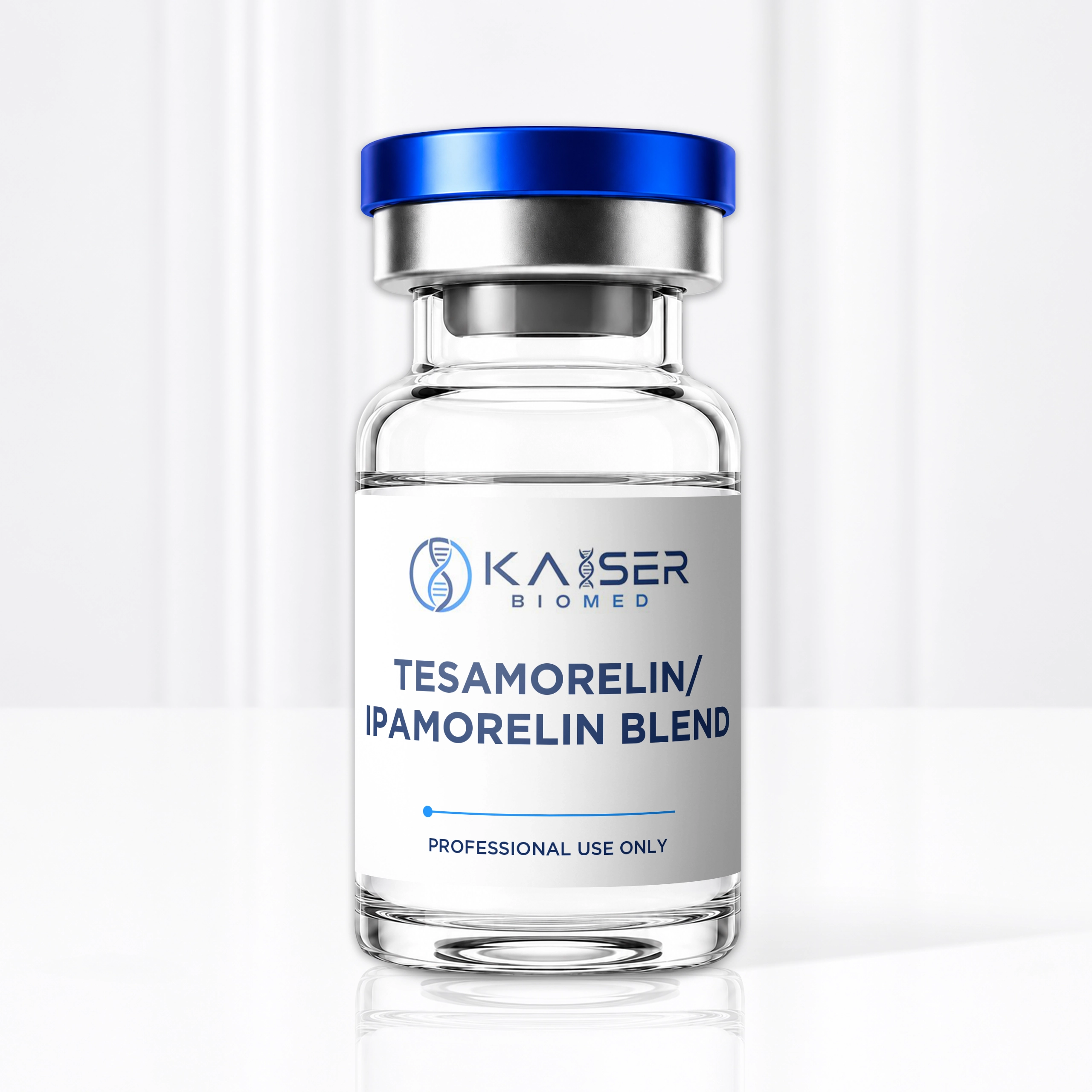
Tesamorelin / Ipamorelin Blend (P-013; Tesamorelin 8 MG + Ipamorelin 2 MG; 10 MG total lyophilized vial) combines the only GHRH analog to complete Phase 3 clinical trials and receive FDA approval (Tesamorelin, brand name EGRIFTA) with the most selective third-generation GHRP (Ipamorelin, NNC 26-0161) to achieve dual-pathway pulsatile GH-axis stimulation with a uniquely clean hormonal selectivity profile. Tesamorelin (TH9507; synthetic human GHRH(1-44) analog with trans-3-hexenoic acid N-terminal modification; CAS 901758-09-6; MW 5,135.9 g/mol; C₂₂₁H₃₆₆N₇₂O₆₇S) is an FDA-approved GHRH analog that drives pulsatile, endogenous GH secretion from the anterior pituitary; Phase 3 randomized trials in HIV-associated lipodystrophy documented 15–18% selective visceral adipose tissue (VAT) reduction over 26 weeks, with preservation of subcutaneous adipose tissue, improved lipid parameters, and no significant glucose perturbation. Ipamorelin (NNC 26-0161; Aib-His-D-2-Nal-D-Phe-Lys-NH₂; CAS 170851-70-4; MW 711.85 g/mol; C₃₈H₄₉N₉O₅) is a synthetic pentapeptide GHS-R1a agonist distinguished from all earlier GHRPs by its exceptional selectivity — producing dose-dependent GH release without significant elevation of ACTH, cortisol, or prolactin at any tested dose, including doses 200-fold above the GH ED₅₀. The combination engages the Gs-cAMP-PKA pathway (Tesamorelin via GHRH-R) and the Gαq/11-PLC-Ca²⁺ pathway (Ipamorelin via GHS-R1a) simultaneously, generating synergistic pulsatile GH release with a hormonal specificity profile that makes this blend the preferred GH-axis research formulation where cortisol and HPA axis integrity must be preserved.
Clinical Research Indications
The Tesamorelin / Ipamorelin Blend spans GH-axis stimulation, body composition, and metabolic research:
- Visceral Adiposity Reduction (Tesamorelin Phase 3 Data): Pooled Phase 3 trials (n=806) demonstrated VAT reduction of −27.71 cm² (MD; P<0.001), 15–18% relative reduction over 26 weeks, with sustained effect at 52 weeks; subcutaneous adipose tissue preserved in both studies.
- Hepatic Steatosis and Liver Fat: JAMA-published RCT (2014) demonstrated concurrent −34 cm² VAT and −2.0% hepatic lipid-to-water reduction with Tesamorelin versus +8 cm² and +0.9% with placebo over 6 months — the first controlled demonstration that selective VAT targeting reduces hepatic fat independently of weight change.
- Clean Pulsatile GH Stimulation (Ipamorelin): As the first GHRP-receptor agonist with GH selectivity matching GHRH, Ipamorelin enables GH axis activation without confounding cortisol, prolactin, or ACTH co-stimulation — critical for research designs where isolated GH pathway effects are required.
- Lean Body Mass and Muscle Density: Phase 3 responder analysis documented significant increases in trunk muscle density across all four truncal muscle groups (rectus abdominis, anterolateral abdominal, psoas major, paraspinal; p<0.005) in Tesamorelin-treated subjects achieving VAT reduction, with upstream IGF-1 modulation.
Contraindications
- Active Neoplasia / IGF-1 Sensitive Tumors: Tesamorelin carries a Boxed Warning for active malignancy due to GH/IGF-1 elevation; use in subjects with active or suspected neoplastic disease requires specialized oncological oversight.
- Pituitary Tumor or Cranial Irradiation History: Tesamorelin’s GHRH-R agonism may stimulate growth of pituitary adenomas; prior cranial irradiation or pituitary structural abnormality warrants caution.
- Glucose Monitoring in Insulin-Resistant Subjects: Phase 3 data showed small but significant HbA1c increase of 0.12% at 26 weeks, reversing by 52 weeks; research designs involving metabolically compromised subjects should include glucose monitoring, particularly in the first 6 months.
- Ipamorelin — Post-Operative Ileus Context: Phase 2 trials of Ipamorelin for post-operative ileus did not proceed to Phase 3; GHS-R1a agonism modulates gastric motility and should be considered in research involving GI physiology endpoints.
Mechanism of Action (MOA)
Tesamorelin and Ipamorelin activate the GH axis through independent receptor systems, producing synergistic pulsatile GH release with an exceptionally selective hormonal profile:
Tesamorelin — GHRH-R Agonism and Pulsatile GH Secretion
Tesamorelin is a synthetic analog of human GHRH(1-44) with an N-terminal trans-3-hexenoic acid modification that confers stability against endopeptidase cleavage while retaining full GHRH receptor (GHRH-R) binding affinity. Binding to GHRH-R on anterior pituitary somatotrophs couples through Gs → adenylyl cyclase → cAMP → PKA → CREB phosphorylation and voltage-dependent Ca²⁺ influx to trigger pulsatile GH exocytosis. Tesamorelin does not alter natural GH feedback regulation — endogenous somatostatin inhibition remains intact — preserving physiological GH pulsatility. Downstream GH → hepatic IGF-1 drives selective visceral adipose lipolysis via hormone-sensitive lipase (HSL) and adipose triglyceride lipase (ATGL) activation.
Ipamorelin — Selective GHS-R1a Agonism (Gαq/11 / Ca²⁺ Pathway)
Ipamorelin (Aib-His-D-2-Nal-D-Phe-Lys-NH₂) activates the ghrelin receptor GHS-R1a via Gαq/11-PLCβ-IP3-Ca²⁺ signaling. Its defining characteristic is exceptional receptor selectivity: at GH-releasing doses, Ipamorelin produces no significant elevation of ACTH, cortisol, prolactin, FSH, LH, or TSH — a specificity confirmed in the original characterization study (Raun et al., 1998, PMID 9849822) even at doses 200× above the GH ED₅₀. The Aib (α-aminoisobutyric acid) substitution at position 1 and D-2-naphthylalanine at position 3 are the structural determinants of this exceptional selectivity, preventing receptor cross-activation observed with older GHRPs such as GHRP-2 and GHRP-6.
Dual-Pathway Synergy: Selective Visceral Fat and GH-Axis Research
The Gs-cAMP pathway (GHRH-R, Tesamorelin) and the Gαq/11-Ca²⁺ pathway (GHS-R1a, Ipamorelin) converge at the somatotroph through complementary second messenger systems, producing synergistic GH release that exceeds either compound alone. Tesamorelin’s GHRH-R-mediated activation counteracts somatostatin-driven inhibition through cAMP signaling; Ipamorelin’s GHS-R1a activation mobilizes intracellular Ca²⁺ stores for direct vesicle exocytosis. Together they drive pulsatile GH — distinct from the sustained elevation produced by long-acting DAC variants — preserving natural feedback and receptor resensitization. Tesamorelin’s documented VAT selectivity over subcutaneous adipose is attributed to differential receptor density and GH/IGF-1 responsiveness between visceral and subcutaneous adipocyte depots.
Key Features & Specifications
Defining clinical and pharmacological attributes of this GH-axis blend:
Chemical Analysis
| Property | Specification Reference Data |
|---|---|
| Component 1 — Tesamorelin | Synthetic GHRH(1-44) analog; 44 AA; trans-3-hexenoic acid N-terminal modification for endopeptidase resistance; synonyms: TH9507; GHRH(1-44)-NH₂-trans-3-hexenoic acid |
| Tesamorelin CAS | 901758-09-6 |
| Tesamorelin Molecular Formula | C221H366N72O67S |
| Tesamorelin Molecular Weight | 5,135.9 g/mol |
| Tesamorelin Half-Life | ~26 minutes (plasma) |
| Component 2 — Ipamorelin | Synthetic pentapeptide GHRP; Aib-His-D-2-Nal-D-Phe-Lys-NH₂ (5 AA; C-terminal amide); NNC 26-0161; selective GHS-R1a agonist |
| Ipamorelin CAS | 170851-70-4 |
| Ipamorelin Molecular Formula | C38H49N9O5 |
| Ipamorelin Molecular Weight | 711.85 g/mol |
| Ipamorelin PubChem CID | 9831659 |
| Ipamorelin Synonyms | NNC 26-0161; Ipamorelin Acetate |
| Ipamorelin Half-Life | ~2 hours (subcutaneous) |
| Form / Variation | 10 MG Lyophilized Blend Vial (P-013) — 8 MG Tesamorelin + 2 MG Ipamorelin |
Storage, Safety, and Handling
Storage Protocol
Store lyophilized blend at −20 °C, protected from light; Tesamorelin is sensitive to temperature excursions above 8 °C in reconstituted form — maintain cold chain throughout. Once reconstituted with bacteriostatic water for injection, store at 2–8 °C and use within 21 days; the reconstituted solution should be clear and colorless. Ipamorelin is stable under standard peptide storage conditions; however, the reconstituted blend should not be exposed to repeated freeze-thaw cycles to protect Tesamorelin integrity.
Handling & Compliance
Handle with standard laboratory PPE and aseptic reconstitution technique. Tesamorelin carries a Boxed Warning regarding active malignancy; institutional research ethics should be in place for studies involving GH/IGF-1 endpoint measurements. Both compounds are prohibited under WADA S2 (Peptide Hormones, Growth Factors, Related Substances). Ipamorelin was evaluated in Phase 2 trials for post-operative ileus (NNC 26-0161); researchers studying GI motility endpoints should factor in GHS-R1a activity on gastric contractility.