
Description
Summary Abstract
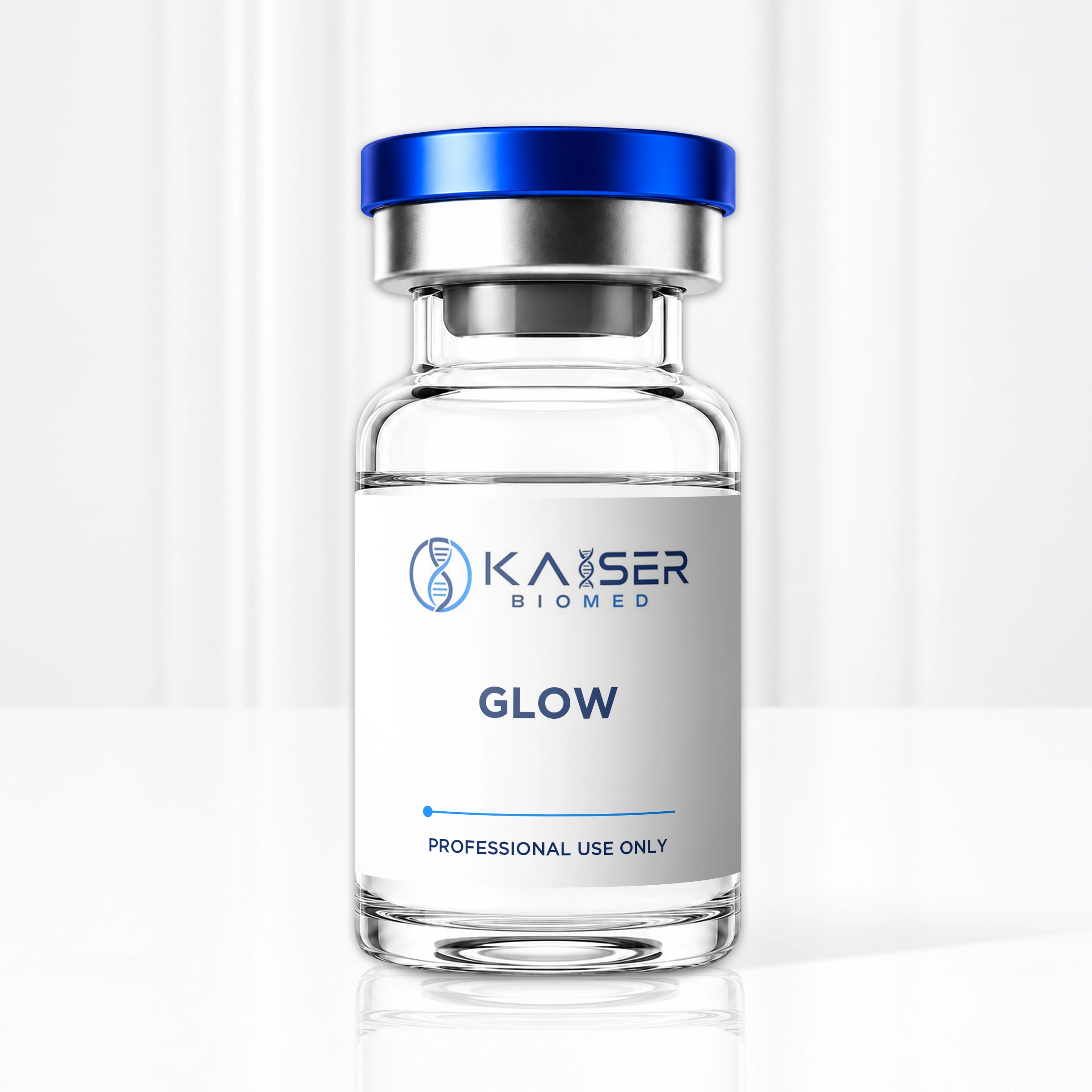
Glow (P-050; GHK-Cu 20 MG + TB-500 15 MG + BPC-157 15 MG; 50 MG total lyophilized blend) is a three-component peptide blend formulated to address complementary and non-redundant stages of the wound-healing and dermal regeneration cascade. Copper glycinate–histidine (GHK-Cu) acts as the collagen synthesis inducer and dermal fibroblast activator; the TB-500 fragment (the LKKTETQ-containing actin-binding domain of thymosin β4) provides G-actin sequestration, promoting directed endothelial and keratinocyte migration; and BPC-157 (GEPPPGKPADDAGLV) supplies angiogenic signaling via VEGFR2 upregulation and nitric oxide system modulation. Together, the three components address the proliferative, migratory, and vascularization phases of tissue repair in a manner that no single component fully recapitulates, making Glow relevant to both dermal wound healing and systemic connective tissue research contexts.
Clinical Indications
The Glow blend’s component MoA profiles support investigation in the following research contexts:
- Dermal Wound Healing and Skin Rejuvenation: GHK-Cu is among the most extensively documented copper-peptide collagen inducers in dermatology literature; combined with TB-500’s cell migration and BPC-157’s angiogenic effects, the blend addresses full-thickness wound healing from matrix synthesis through vascular ingrowth.
- Tendon and Connective Tissue Repair: BPC-157’s FAK-paxillin pathway activity in fibroblasts and TB-500’s actin-sequestration-driven cell motility combine to accelerate organized collagen deposition in tendon repair models.
- Post-Procedural Skin Recovery: The anti-inflammatory and proliferative properties of GHK-Cu and BPC-157 make this blend relevant to research on post-procedural skin recovery following ablative or surgical interventions, where vascular re-establishment and matrix re-synthesis are rate-limiting steps.
Contraindications
- Active Malignancy: All three components have pro-angiogenic or pro-proliferative properties (particularly BPC-157’s VEGFR2 mechanism and GHK-Cu’s matrix metalloproteinase regulation); use in active oncological disease requires careful consideration of tumor vascularization risk.
- Known Copper Overload Disorders: GHK-Cu contributes a bioavailable copper ligand; individuals with Wilson disease or other copper metabolism disorders should exercise caution given systemic copper load considerations.
- Pregnancy: The combination has not been evaluated in pregnancy; pro-angiogenic and tissue-remodeling signals represent an incompletely characterized risk in the gestational context.
Mechanism of Action (MOA)
Each component contributes a distinct and complementary mechanism to the overall wound-healing and regenerative response:
GHK-Cu — Copper Tripeptide Collagen Synthesis
GHK-Cu (glycyl-L-histidyl-L-lysine:copper(II)) binds copper(II) with high affinity and delivers it to extracellular matrix-remodeling enzymes including lysyl oxidase and superoxide dismutase. It upregulates transcription of collagen I, III, and IV, elastin, and fibronectin in dermal fibroblasts while simultaneously inducing matrix metalloproteinase (MMP) activity to clear damaged collagen — a “remove and rebuild” mechanism that distinguishes GHK-Cu from simple collagen precursor supplements. Additionally, GHK-Cu activates VEGF, TGF-β, and FGF signaling, creating a growth factor-rich microenvironment supportive of full skin regeneration.
TB-500 — Actin Sequestration and Directed Cell Migration
TB-500 (the LKKTETQ actin-binding domain fragment of thymosin β4) sequesters monomeric G-actin in a 1:1 complex, tuning the G-actin/F-actin equilibrium that drives cytoskeletal remodeling in migrating cells. Downstream, this actin regulation translates into directional migration of endothelial cells, keratinocytes, and fibroblasts toward wound edges — the fundamental cellular process that closes skin defects and restores tissue continuity. TB-500 also activates the PINCH-ILK-Akt survival axis in cardiomyocytes and reduces inflammatory cytokine burden in wound environments.
BPC-157 — VEGFR2 Angiogenesis and NO-Mediated Cytoprotection
BPC-157 (GEPPPGKPADDAGLV) upregulates vascular endothelial growth factor receptor 2 (VEGFR2) in endothelial cells, driving new capillary formation that restores blood flow and oxygen delivery to healing tissue — the vascularization step that ultimately determines wound closure speed and quality. Simultaneously, BPC-157’s bidirectional NO system modulation protects regenerating tissue from ischemic and inflammatory oxidative damage, and FAK-paxillin pathway activation reinforces fibroblast migration and collagen organization within the new tissue matrix.
Key Features & Specifications
Defining properties of the Glow three-component synergistic blend:
Chemical Analysis
| Property | Specification Reference Data |
|---|---|
| Component 1 — GHK-Cu | Gly-His-Lys copper(II) complex; CAS 49557-75-7; MW 340.38 g/mol (free peptide); 20 MG per vial |
| Component 2 — TB-500 | LKKTETQ-containing thymosin β4 fragment (typically the 4–14 AA active domain); MW ~887 g/mol (heptapeptide LKKTETQ); 15 MG per vial |
| Component 3 — BPC-157 | GEPPPGKPADDAGLV; CAS 137525-51-0; MW 1419.53 g/mol; 15 MG per vial |
| Total Blend | 50 MG lyophilized powder |
| Form / Variation | Lyophilized powder, single vial (P-050) — $112.00 |
Storage, Safety, and Handling
Storage Protocol
Store lyophilized Glow blend at −20 °C, protected from light and moisture. Reconstitute with bacteriostatic water for injection using aseptic technique; add solvent slowly along the vial wall and swirl gently — do not vortex. The reconstituted solution is stable at 2–8 °C for up to 28 days. Note that GHK-Cu may exhibit slightly slower dissolution due to copper coordination chemistry; gently warming the vial to room temperature before reconstitution aids dissolution.
Handling & Compliance
Handle with standard laboratory PPE. BPC-157 is listed under WADA S4 (Hormone and Metabolic Modulators); TB-500 / thymosin β4 is listed under WADA S4 as well; relevant compliance obligations apply in competitive sports contexts. All three components have pro-proliferative and/or pro-angiogenic properties; use in active oncological conditions requires consideration. GHK-Cu contributes bioavailable copper — account for cumulative copper exposure in long-term protocols.