
Description
Summary Abstract
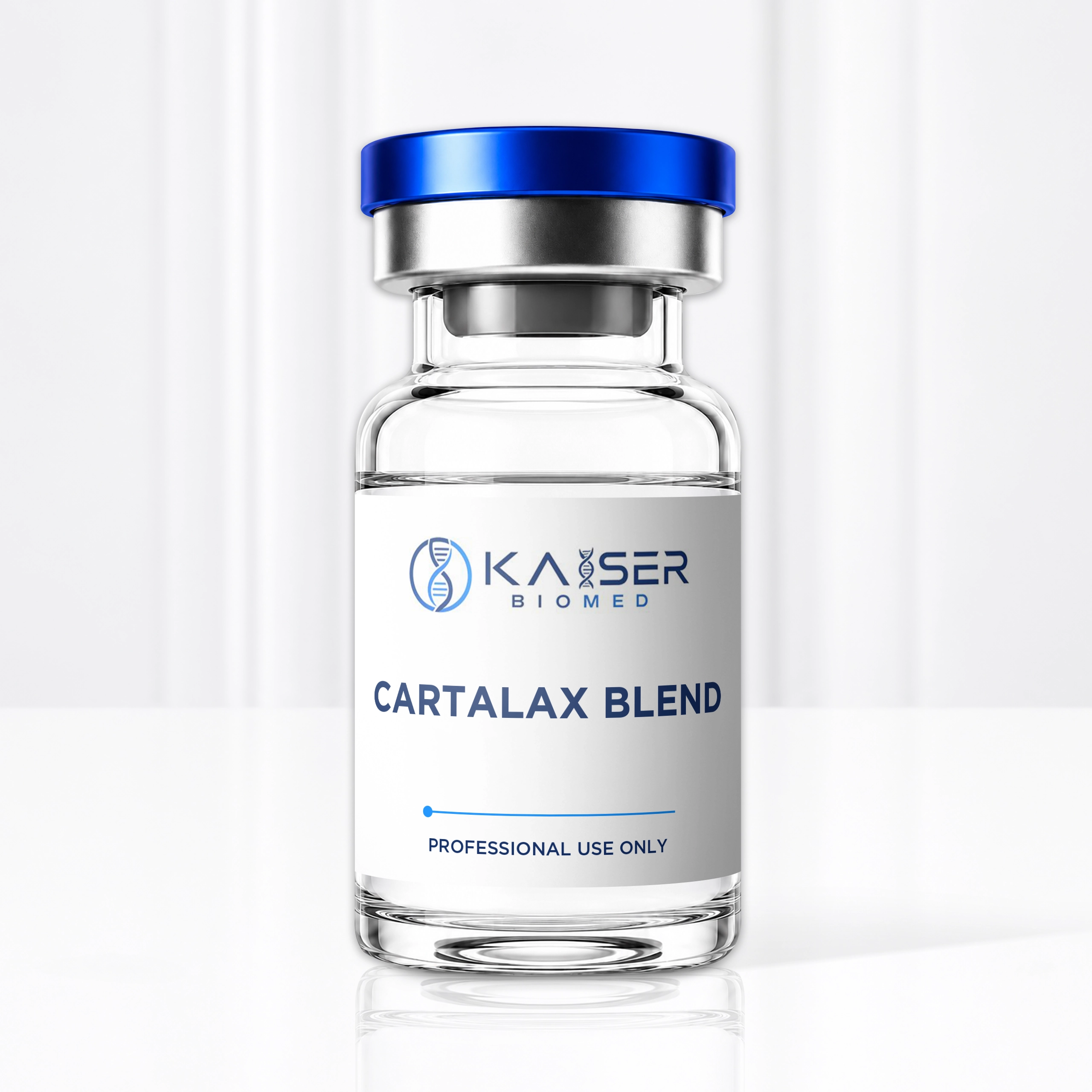
Cartalax Blend (P-067; Cartalax 20 MG + BPC-157 20 MG + TB-500 20 MG + KPV 20 MG; 80 MG total lyophilized blend) is a four-component formulation designed for connective tissue, cartilage, and wound repair research. Cartalax (Ala-Glu-Asp) is a chondrocyte-targeting bioregulatory tripeptide proposed to upregulate collagen type II and aggrecan transcription via epigenetic modulation, derived from the Khavinson bioregulator program. BPC-157 (Body Protection Compound-157; GEPPPGKPADDAGLV) contributes pro-angiogenic and cytoprotective activity via the VEGFR2/NO/FAK-paxillin axis. TB-500 (thymosin β4 fragment LKKTETQ) provides actin-sequestration–dependent cell migration and tissue remodeling support. KPV (Lys-Pro-Val; α-MSH C-terminal tripeptide) delivers targeted NF-κB inhibition and MAPK pathway suppression via PepT1-mediated intracellular entry in inflamed tissue. Together, the four components address the cartilage catabolic cascade, tissue vascularization, cytoskeletal remodeling, and chronic inflammatory signaling in a single lyophilized preparation.
Clinical Indications
Each component targets a distinct layer of connective tissue pathology, with collective relevance to the following research contexts:
- Cartilage Matrix Support: Cartalax upregulates collagen type II (COL2A1) and aggrecan (ACAN) gene expression in chondrocytes, addressing the anabolic deficit in degenerative joint research while suppressing MMP-1/MMP-13 catabolic enzymes.
- Tendon, Ligament, and Wound Repair: BPC-157 and TB-500 both demonstrate accelerated repair in tendon transection and wound closure models through complementary angiogenic and actin-remodeling pathways.
- Mucosal and Gastrointestinal Inflammation: KPV’s PepT1-mediated gut delivery and BPC-157’s gastric cytoprotective properties combine for multi-targeted mucosal protection in IBD and colitis research models.
- Systemic and Dermal Inflammation: KPV’s NF-κB inhibition and TB-500’s anti-inflammatory activity support investigation of wound-associated and systemic inflammatory states where multiple pathways contribute to tissue damage.
Contraindications
- Active Malignancy: Pro-angiogenic components (BPC-157 VEGFR2/NO axis; TB-500 VEGF-dependent signaling) carry a theoretical risk of supporting tumor neovascularization; use in oncological contexts requires consideration of tumor angiogenesis potential.
- Broad Immunosuppressive States: KPV’s NF-κB inhibition may attenuate physiological inflammatory responses required for pathogen clearance; use in severely immunocompromised subjects requires assessment.
- Pregnancy and Lactation: No reproductive safety data exist for any component; use is not established in pregnant or lactating individuals.
- Multi-Peptide Hypersensitivity: Blended formulations increase hypersensitivity surface area; documented sensitivity to any constituent peptide represents a contraindication.
Mechanism of Action (MOA)
Each component engages a distinct molecular pathway, producing complementary and synergistic effects on connective tissue repair and inflammation resolution:
Cartalax — Chondrocyte Epigenetic Gene Regulation
Cartalax (Ala-Glu-Asp) is a bioregulatory tripeptide hypothesized to translocate to the nucleus in chondrocytes, where it interacts with chromatin regulatory elements to upregulate transcription of collagen type II alpha-1 (COL2A1) and aggrecan (ACAN) — the primary structural proteins of articular cartilage extracellular matrix. Preclinical evidence also indicates downregulation of matrix metalloproteinase (MMP)-1 and MMP-13 catabolic enzymes, shifting the anabolic/catabolic balance toward matrix preservation.
BPC-157 — VEGFR2/NO/FAK-Paxillin Angiogenesis and Cytoprotection
BPC-157 upregulates vascular endothelial growth factor receptor 2 (VEGFR2) and modulates the nitric oxide (NO) system bidirectionally, promoting angiogenesis and vascular remodeling in ischemic and injured tissue. Activation of the FAK-paxillin integrin pathway enhances fibroblast and tenocyte migration, accelerating extracellular matrix deposition and tensile strength recovery in tendon, ligament, and mucosal injury models.
TB-500 — G-Actin Sequestration and Cytoskeletal Remodeling
TB-500 (thymosin β4 fragment, LKKTETQ) maintains the intracellular G-actin monomer pool through 1:1 stoichiometric sequestration of unpolymerized actin, modulating the G-actin/F-actin ratio to promote lamellipodia formation and directed cell migration. Downstream VEGF-dependent paracrine signaling and PINCH–ILK–Akt pathway engagement support endothelial recruitment and anti-apoptotic responses in cardiac and skeletal muscle ischemia models.
KPV — PepT1-Mediated Intracellular NF-κB and MAPK Inhibition
KPV (Lys-Pro-Val) enters epithelial and immune cells via the peptide transporter PepT1 (SLC15A1), bypassing cell-surface receptor engagement entirely. Intracellularly, KPV competes with importin-α for binding at armadillo domains 7 and 8 of NF-κB p65/RelA, blocking nuclear translocation and suppressing TNF-α, IL-1β, IL-6, and IL-8 transcription. Parallel ERK/p38 MAPK inhibition further broadens the anti-inflammatory profile across cell types including keratinocytes, macrophages, and intestinal epithelial cells.
Key Features & Specifications
Four mechanistically complementary components address cartilage repair, tissue vascularization, cytoskeletal remodeling, and NF-κB–mediated inflammation in a single 80 MG preparation:
Chemical Analysis
| Property | Specification Reference Data |
|---|---|
| Component 1 — Cartalax | Sequence: Ala-Glu-Asp (AED tripeptide bioregulator); MW: ~333.3 g/mol; Tissue target: chondrocytes |
| Component 2 — BPC-157 | Sequence: GEPPPGKPADDAGLV; CAS: 137525-51-0; MW: 1419.53 g/mol; Origin: gastric juice protein fragment |
| Component 3 — TB-500 | Sequence: LKKTETQ (thymosin β4 fragment, residues 17–23); CAS: 885340-08-9; MW: 831.96 g/mol; Full Tβ4: 43 AA, MW 4963.5 g/mol |
| Component 4 — KPV | Sequence: Lys-Pro-Val; CAS: 6057-43-8; MW: ~342.4 g/mol; Parent: α-MSH C-terminus (residues 11–13) |
| Blend Composition | Cartalax 20 MG + BPC-157 20 MG + TB-500 20 MG + KPV 20 MG = 80 MG total lyophilized |
| Form / Variation | 80 MG Lyophilized Blend (P-067) — single SKU; reconstitute with bacteriostatic water |
| Synonyms | Cartalax Blend; Connective Tissue Quad Blend; KBM Cartalax Combo |
Storage, Safety, and Handling
Storage Protocol
Store lyophilized blend at −20 °C, shielded from light and moisture. Upon reconstitution with bacteriostatic water, the solution is stable at 2–8 °C for up to 28 days per USP <797> multi-dose container guidance; avoid repeated freeze-thaw cycling after reconstitution. The shortest-stability component in the blend governs the practical beyond-use date.
Handling & Compliance
Handle under standard laboratory precautions (nitrile gloves, safety glasses) using aseptic technique throughout reconstitution. Each component carries its own pharmacological activity; personnel should be familiar with the mechanisms and safety profiles of all four constituents before use. TB-500 (thymosin β4 and fragments) is classified as a prohibited substance under the World Anti-Doping Agency (WADA) S2 Peptide Hormone category.